
Cooling blankets for recovery are large, flexible cold therapy blankets made of connected gel cells that you chill in the freezer or fridge and drape over sore muscles, swollen joints or an overheated body. They cover far more area than a standard ice pack, so they work well on the back, thighs, shoulders and whole limbs. Athletes use them after hard sessions, patients use them during rehab and after surgery, and many people use them simply to cool down and rest more comfortably.
This guide explains how cooling blankets work, their seven main benefits, who uses them, how they compare with ice packs and ice baths, what the research actually says, and how to use one safely.
Key takeaways
- A cooling blanket is a wide, flexible cold pack that covers large areas like the back, thighs or a full leg in one session.
- Cold narrows blood vessels and slows nerve signals, which eases pain and limits swelling in the first days after an injury or a hard workout.
- Use cooling blankets for recovery in sessions of 10 to 20 minutes with a cloth barrier, and wait at least 1 to 2 hours between sessions.
- Research supports cold for short-term relief of pain and muscle soreness, but icing nonstop for days is not recommended.
- Reusable gel blankets such as the THERAPRO™ Hot Cold Therapy Blanket can also be heated, so one product covers both cold and heat therapy.
In this guide
What is a cooling blanket?
A cooling blanket is a flexible sheet that holds cold against a large part of the body. The term covers three different products, so it helps to know which one you need:
- Cold therapy gel blankets (ice blankets): rows of small gel cells joined in one sheet. You freeze or chill them, then wrap them around the body for pain relief and recovery. This is the type this guide focuses on.
- Medical cooling blankets: hospital systems that circulate cool water through a pad to lower a patient’s body temperature, for example during a high fever. Only clinical staff use these.
- Cooling bed blankets: breathable fabrics that pull heat and moisture away while you sleep. They make nights more comfortable but do not deliver cold therapy.
When people look for cooling blankets for recovery, they usually mean the first type. For a closer look at how gel ice blankets are built, read our guide on what an ice blanket is and how it is used.
How do cooling blankets help the body recover?
Cold works on the body in three simple ways. First, it narrows blood vessels near the skin, which reduces the flow of fluid into injured or overworked tissue and helps keep swelling down. Second, it slows the nerve signals that carry pain, so the area feels less sore while it is cold and for a while afterward. Third, it lowers the temperature of the tissue, which slows local metabolism and can make tight, aching muscles feel calmer.
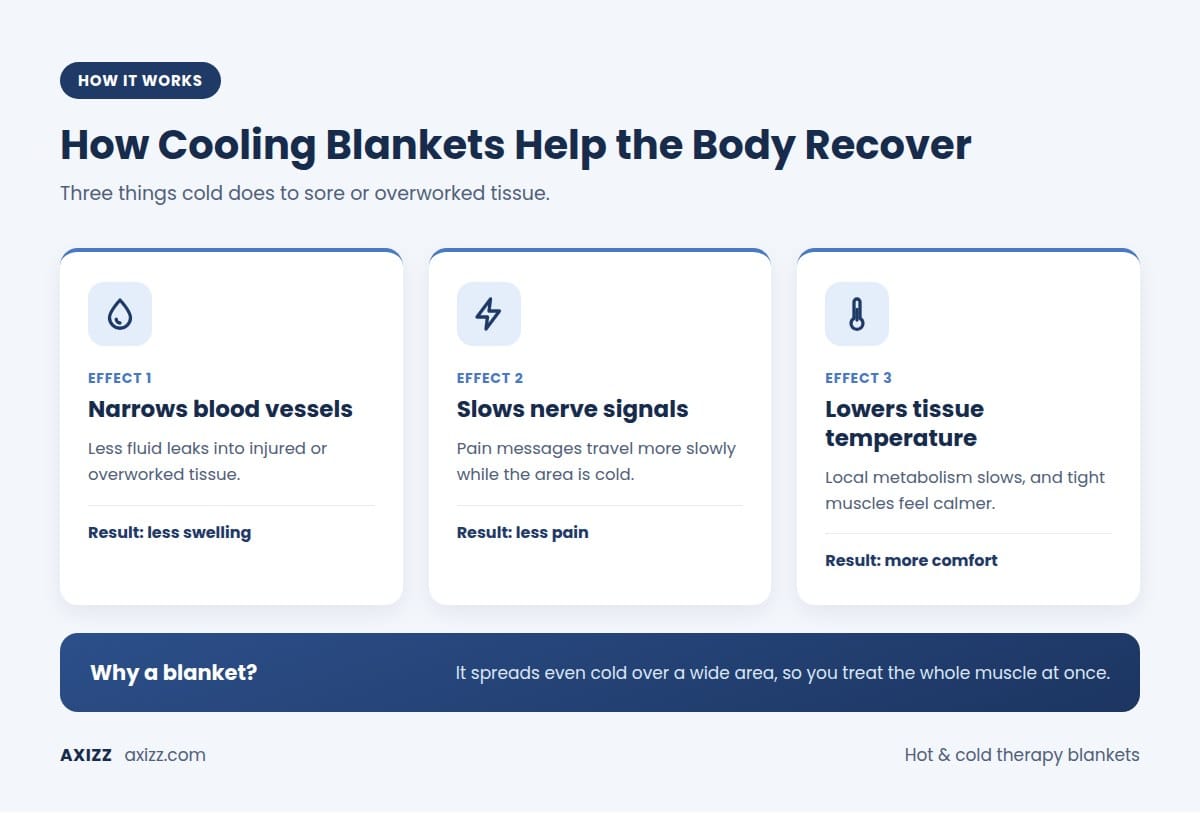
A blanket applies this cold over a wide surface at an even temperature. Instead of moving a small pack from spot to spot, you can cover the whole hamstring, lower back or both shoulders at once. That is the main reason cooling blankets are popular for full-body soreness and for larger joints like the knee and hip. To go deeper on the science, see how cold therapy for muscle recovery speeds up repair.
7 benefits of cooling blankets for recovery
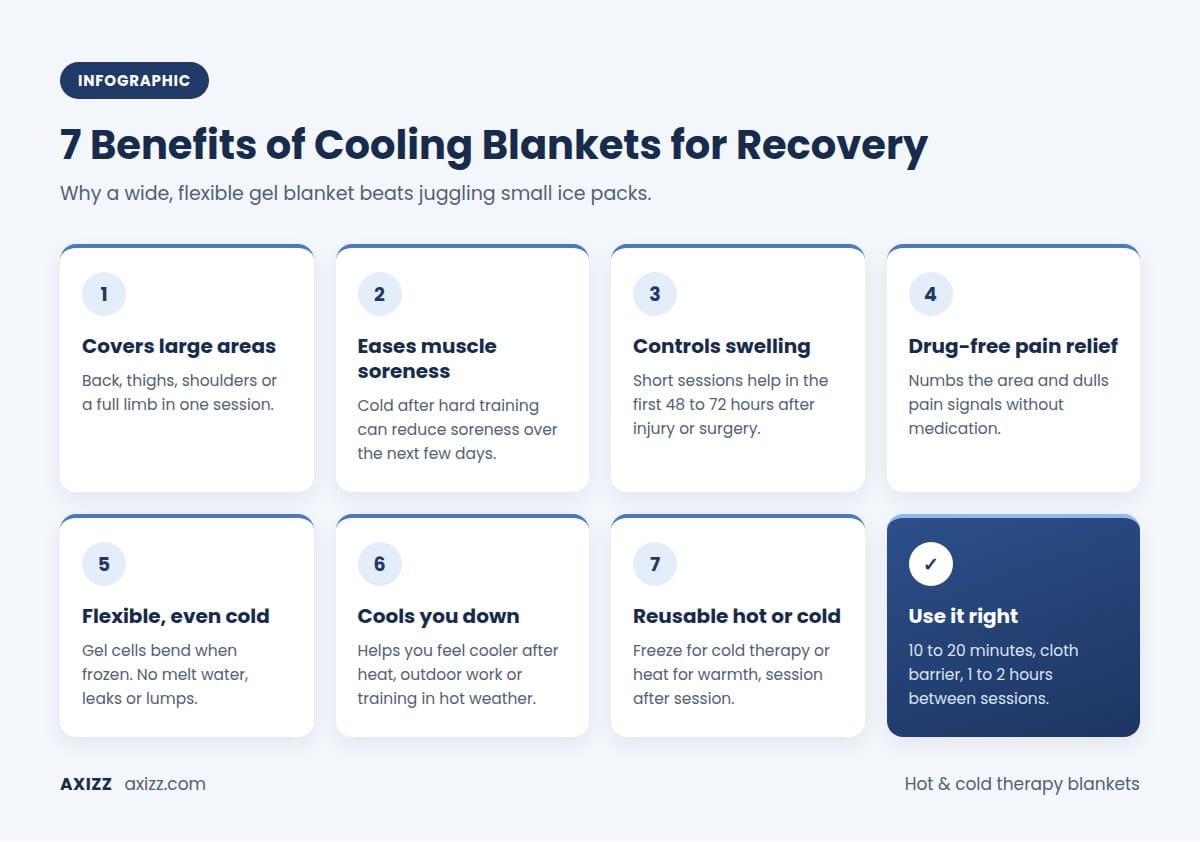
1. Covers large muscle groups in one session
Most ice packs cover a patch about the size of your hand. A cooling blanket can wrap around a thigh, cover the upper back or sit across both calves. You get consistent cold across the entire sore area without juggling several packs.
2. Eases muscle soreness after exercise
Delayed onset muscle soreness usually peaks one to three days after hard or unfamiliar training. A Cochrane review of 17 small trials with 366 people found that cold applied after exercise, in the form of cold-water immersion, reduced soreness at 24, 48, 72 and 96 hours compared with resting. The trials were small and the evidence quality was low, but the results line up with what many athletes report when they use cold after training.
3. Helps control swelling after injury or surgery
In the first 48 to 72 hours after a sprain, strain or procedure, swelling is often the main source of pain and stiffness. Short cold sessions help limit it. That is why cold therapy is a routine part of post-surgical recovery and of rehabilitation programs that use ice blankets.
4. Drug-free pain relief
Cold numbs the area and dulls pain signals without medication. For people who want to limit painkillers, or who need relief between doses, a cooling blanket is a simple option to use at home. Learn more about cold therapy for inflammation and pain.
5. Even, flexible cold that fits the body
Gel cells stay soft enough to bend even when frozen, so the blanket molds around knees, elbows and shoulders. Unlike a bag of ice, it does not melt into water, leak or turn lumpy, and it holds a steady temperature for longer. It is the same advantage that makes gel ice packs better than traditional ice.
6. Cools you down after heat exposure
After training in hot weather, working outdoors or a long shift in a warm workplace, a chilled blanket over the neck, shoulders and upper back helps you feel cooler faster. It works well alongside shade, fluids and rest. Our guides to cooling solutions for outdoor sports and reducing heat stress at work cover this in more detail. If someone shows signs of heat stroke, such as confusion or hot, dry skin, call emergency services first.
7. Reusable for both hot and cold therapy
A good gel blanket lasts for many sessions, so it costs less over time than disposable cold packs. The THERAPRO™ Hot Cold Therapy Blanket goes one step further. It ships dry and light, you hydrate it in water, and then you can freeze it for cold therapy or heat it for warmth. It is 18.5 inches wide, is made of small 3 x 3.7 inch gel cells, and can be cut to the size you need.
Who uses cooling blankets for recovery?
Athletes and active people
Runners, lifters, team sport players and weekend hikers use cooling blankets after long or intense sessions, especially on big muscle groups like the quads, hamstrings, glutes and back. A 15-minute session while you rest and refuel fits easily into a cool-down routine. Here is why muscle recovery matters for active lifestyles.
Post-surgery and rehabilitation patients
After knee, hip, shoulder or back procedures, surgeons and physical therapists often recommend scheduled cold sessions to manage swelling and pain. A blanket is easier to position around a bulky dressing or brace than a small pack. Always follow the schedule your care team gives you. Our post on how ice blankets support faster recovery covers this in more depth.
Everyday wellness and hot sleepers
Many people use a cooling blanket to unwind after a long day, ease tension or cool off on hot nights. Your core body temperature naturally drops in the hours before sleep, and the Sleep Foundation suggests keeping the bedroom around 65 to 68°F (18 to 20°C). A chilled blanket used for a few minutes before bed can help you feel cooler, but do not fall asleep with a frozen pack against your skin. For more ideas, read how cold therapy products support everyday wellness.
Horses and working animals
Recovery is not only for people. Equine therapy blankets apply the same hot and cold principles to a horse’s back, legs and muscles after work or competition. Axizz offers a hot and cold therapy blanket for horses, and our guide explains how a horse therapy blanket helps recovery.
Cooling blanket vs ice pack vs ice bath
Each cold therapy option has its place. Here is how they compare for everyday recovery.
| Cooling blanket | Gel ice pack | Ice bath | |
|---|---|---|---|
| Coverage | Large areas: back, thighs, full limbs | Small, targeted spots | Most of the body |
| Best for | Broad soreness, large joints, cooling down | Sprains, bruises, small joints | Whole-body soreness after hard events |
| Session length | 10 to 20 minutes | 10 to 20 minutes | Short dips in cold water |
| Mess | None, no melt water | None | Needs a tub, lots of ice and cleanup |
| Reusable | Yes | Yes | Ice is used once |
| Easy at home | Very easy | Very easy | Harder to set up |
For small, targeted areas, a gel pack or a CRYOPAK™ Ice Pack Wrap is often enough. For wide areas or soreness across a whole limb, a blanket is the more comfortable choice.
What does the research say about cold therapy for recovery?
The evidence for cold is solid for short-term comfort and more mixed for long-term healing. The Cochrane review mentioned above found less muscle soreness after cold-water immersion, but its authors noted that the trials were small, used different methods and did not track side effects well.
Sports medicine has also moved away from icing everything. An editorial in the British Journal of Sports Medicine that introduced the PEACE and LOVE approach to soft tissue injuries points out that ice mostly relieves pain and that there is little high-quality evidence it speeds up tissue healing. The authors also warn that heavy use of anti-inflammatory treatments may slow repair.
The practical takeaway is simple. Use cooling blankets for recovery to ease pain and swelling in the early days, keep sessions short, and pair them with gentle movement and gradual loading as the area improves. Cold helps you feel better so you can move, and movement is what rebuilds the tissue.
A simple cooling blanket routine after a hard workout
Here is an easy routine that works for most active people on heavy training days or after a long event:
- Right after training: cool down with a few minutes of easy walking or stretching, then lie back with the chilled blanket over your sorest muscle group for 10 to 15 minutes.
- Later the same day: if the area still aches, do one more short session at least 1 to 2 hours after the first.
- The next one to two days: use the blanket when soreness flares, and keep moving with light activity like walking, cycling or mobility work.
- Once swelling settles: switch to heat for stiffness and tight muscles. A hot and cold blanket lets you do this with the same product.
One note for strength athletes. A 2015 study in The Journal of Physiology found that regular cold-water immersion right after strength training reduced long-term gains in muscle size and strength. If building muscle is your main goal, save cold sessions for days when soreness or swelling really gets in the way, and skip them after every lifting session.
How to use a cooling blanket safely
Follow these steps each time you use one. They are based on guidance from Cleveland Clinic on icing injuries.
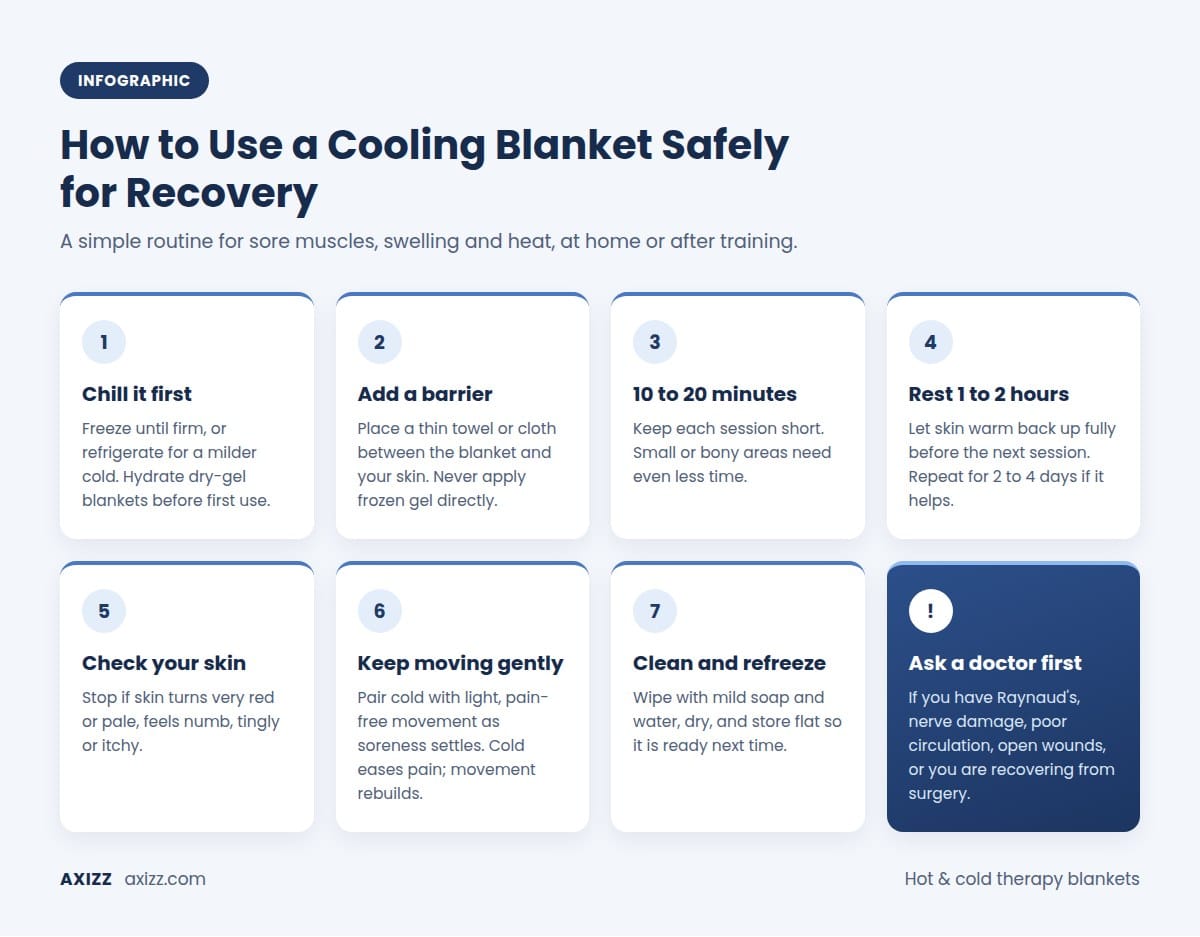
- Chill it. Freeze the blanket until firm, or keep it in the fridge for a gentler cold. If it ships dry, like the THERAPRO blanket, hydrate it in water first.
- Add a barrier. Place a thin towel, pillowcase or cloth between the blanket and your skin.
- Keep it to 10 to 20 minutes. Many injuries need only 10 to 15 minutes. Small areas like fingers need even less.
- Rest 1 to 2 hours between sessions. Let the skin warm back up fully. Repeat for 2 to 4 days if it keeps helping.
- Check your skin. Stop if the skin turns very red or pale, or feels numb, prickly, tingly or itchy.
- Keep moving gently. Add light, pain-free movement as the soreness eases.
- Clean and store it. Wipe it with mild soap and water, dry it, and store it flat in the freezer.
Who should talk to a doctor first
Check with a doctor or physical therapist before using cold therapy if you have Raynaud’s syndrome, nerve damage or neuropathy (common with diabetes), poor circulation, or any condition that reduces how well you feel cold. Children and older adults need shorter sessions and closer watching. Never place a cold blanket over open wounds, blisters, burns or broken skin. After surgery, your surgeon’s instructions come before any general guide.
How to choose the right cooling blanket
- Size and coverage: pick a blanket large enough to wrap the area you treat most, or one you can cut to size.
- Flexibility when frozen: the gel cells should bend around joints instead of freezing into a solid slab.
- Hot and cold use: a blanket that can also be heated handles stiffness and chronic tightness, not just fresh soreness.
- Leak-proof build: look for sealed cells that will not split or leak after repeated freezing.
- Reusability: a durable blanket saves money compared with single-use cold packs. Here is why reusable therapy products make sense.
- Easy care: wipe-clean surfaces and a cloth sleeve make daily use easier.
Frequently asked questions
What are cooling blankets for recovery used for?
They apply cold to large areas of the body to ease muscle soreness, reduce swelling, relieve pain and cool you down after heat exposure. Athletes, post-surgery patients, rehab clinics and people with everyday aches all use them.
How long should you use a cooling blanket?
Use it for 10 to 20 minutes at a time with a cloth barrier between the blanket and your skin. Wait at least 1 to 2 hours before the next session so your skin can warm up fully.
Is a cooling blanket better than an ice pack?
It depends on the area. A cooling blanket is better for large areas such as the back, thighs or a full limb. A gel ice pack is better for small spots like a wrist or ankle. Both give steady cold without melt water.
Can you sleep with a cooling blanket?
You can sleep under a fabric cooling bed blanket. You should not fall asleep with a frozen gel blanket against your skin, because long contact with cold can damage it. Use a chilled gel blanket for a short session before bed instead.
Should I use cold or heat for sore muscles?
Cold is usually best in the first 48 to 72 hours after an injury or a very hard workout, when swelling and fresh soreness are the main problem. Heat works better later for stiffness and tight muscles. A hot and cold therapy blanket lets you do both.
Are cooling blankets safe after surgery?
Cold therapy is commonly recommended after many procedures to control pain and swelling. Keep the dressing dry, use a barrier, keep sessions short and always follow the schedule your surgeon or physical therapist gives you.
How do you clean a gel cooling blanket?
Wipe it with a cloth, mild soap and warm water, rinse, and let it dry before putting it back in the freezer. Avoid harsh chemicals and sharp objects that could puncture the gel cells.
Final thoughts
Cooling blankets for recovery give you steady, mess-free cold over a large area, which makes them one of the easiest ways to handle post-workout soreness, swelling after an injury or surgery, and overheating. Use them in short sessions, protect your skin, and combine them with rest and gentle movement. If you want a reusable option that works hot or cold, take a look at the THERAPRO™ Hot Cold Therapy Blanket, or contact the Axizz team for help choosing the right size.