
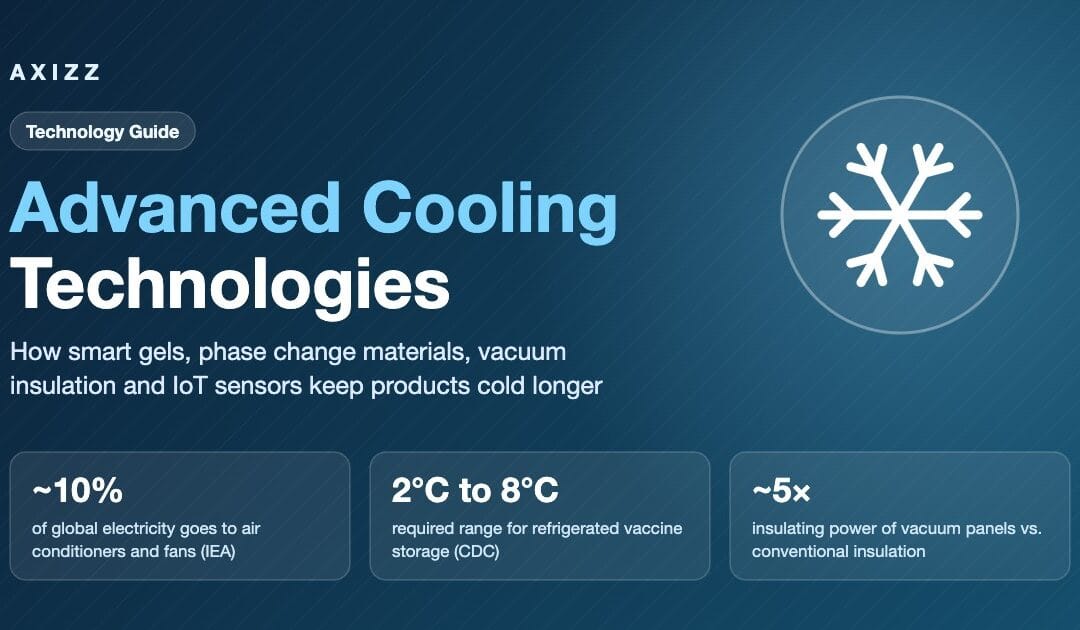
Advanced cooling technologies are materials and systems that keep products, people and spaces at a controlled temperature for longer, using less energy and creating less waste than loose ice or basic refrigeration. The main types are high-performance gels, phase change materials, vacuum insulation, smart temperature monitoring and wearable cooling.
Demand is climbing fast. Vaccines, biologics, meal kits and fresh food travel farther than ever, and summers are getting hotter for people who work outdoors. At the same time, the International Energy Agency (IEA) reports that air conditioners and electric fans already use about 10% of all global electricity. Passive technologies that store and hold cold without plugging into anything are a big part of the answer.
This guide explains how each of these advanced cooling technologies works, where it performs best, and how to pick the right one for your business.
Key takeaways
- Advanced cooling technologies fall into four groups: materials that store cold, insulation that keeps it in, sensors that prove it, and wearables that cool people.
- Phase change materials hold one exact temperature, which makes them a go-to choice for 2°C to 8°C pharmaceutical shipments.
- Vacuum insulated panels deliver about five times the insulating power of conventional insulation at the same thickness.
- Reusable gel packs cut waste and lower the cost per use compared with single-use ice and dry ice.
- The right choice depends on your temperature range, transit time, payload and compliance needs.
What Are Advanced Cooling Technologies?
Traditional cooling relies on two things: ice and a box. Ice melts into water, leaks and warms up unevenly. Basic foam coolers slow heat down, but not for long.
Advanced cooling technologies improve every part of that setup. They work on three levers:
- Store cold more efficiently with engineered gels and phase change materials.
- Keep heat out longer with high-performance insulation such as vacuum panels.
- Prove the temperature held with data loggers and connected sensors.
A fourth group, personal and wearable cooling, applies the same science to people instead of packages. Cooling vests, bandanas and cold therapy wraps use gels and evaporation to lower body or skin temperature safely.
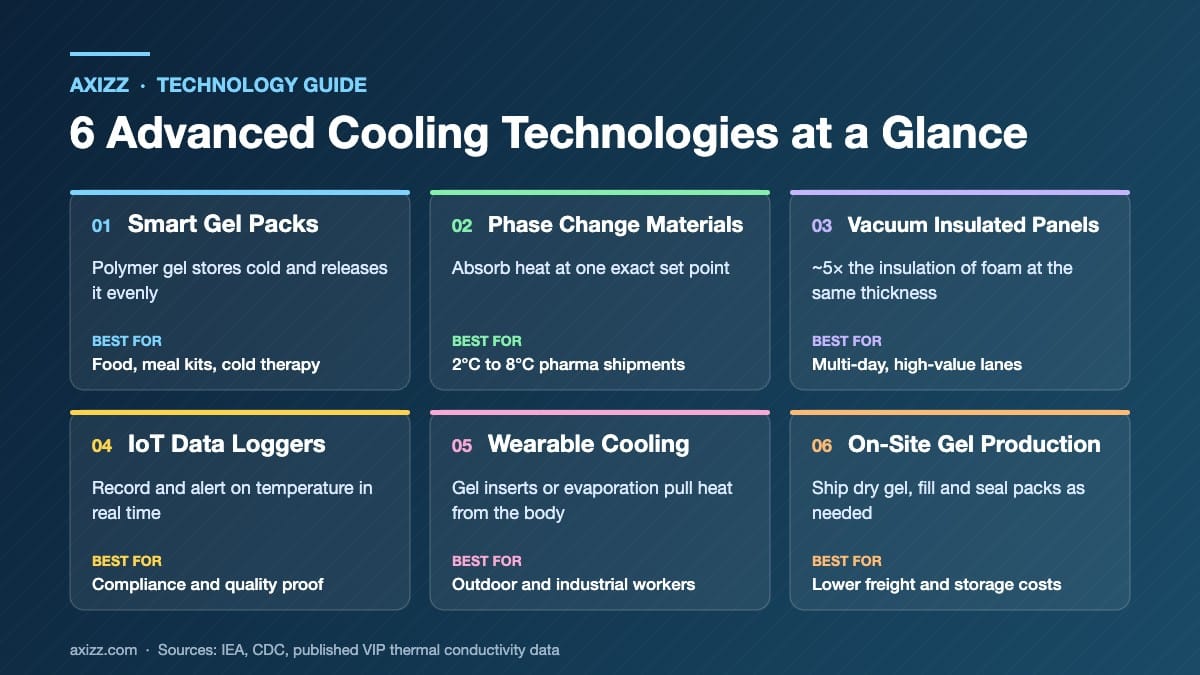
6 Advanced Cooling Technologies and How They Work
1. High-Performance Gel Formulations
Modern gel ice packs use superabsorbent polymers that lock water into a thick gel. The gel freezes and thaws slowly, releases cold evenly and does not turn into a puddle when it melts. That makes gel packs cleaner and more predictable than loose ice. Here is a closer look at why gel ice packs are better than traditional ice.
Newer formulas go further. An additive like the TEMTRO™ SGP soft gel pack additive keeps packs soft and flexible even when frozen, so they wrap around products or sore joints instead of sitting like a brick. Dry gel also lets businesses ship a light powder and add water on site.
2. Phase Change Materials (PCMs)
A phase change material absorbs a large amount of heat as it melts, while its own temperature stays almost flat. Water does this at 0°C. Engineered PCMs do it at the exact point you need, such as 5°C for refrigerated medicine or -20°C for frozen goods.
That flat temperature plateau is why PCMs are popular in pharmaceutical cold chains. The CDC requires refrigerated vaccines to stay between 2°C and 8°C (36°F and 46°F). A PCM tuned to that window protects the product from both warming and accidental freezing.
3. Vacuum Insulated Panels (VIPs)
Vacuum insulated panels remove the air from a rigid core and seal it inside a barrier film. With almost no air left to carry heat, a VIP has roughly one-fifth the thermal conductivity of conventional insulation. In other words, it insulates about five times better at the same thickness.
Thinner walls mean more room for product and smaller, lighter shippers. VIPs cost more than foam, so they are mostly used in reusable, high-value shipping systems for pharmaceuticals and biologics. Our guide to cold chain packaging shows how VIPs fit into a complete shipper.
4. Smart Temperature Monitoring and IoT Sensors
Cooling only counts if you can prove it worked. Digital data loggers record temperature through the whole trip, and connected IoT sensors send live alerts when a shipment drifts out of range. The CDC puts it simply: the only way to know the temperature of a storage unit is to measure and monitor it.
For businesses, this data answers three questions fast. Did the product stay in range? Where did a problem start? Which packaging setup performs best on each route? Learn how monitoring supports safe transportation of temperature-sensitive products.
5. Wearable and Evaporative Cooling
Advanced cooling technologies are not only for boxes. Cooling vests, neck bandanas and hard hat pads use water-activated crystals or chilled gel inserts to pull heat away from the body. Evaporative fabrics cool as moisture evaporates, which works especially well in dry heat.
For outdoor crews, warehouse staff and athletes, wearable cooling helps reduce heat stress and fatigue. The COOLMOR™ Cooling Vest is reusable and needs no batteries. See how cooling vests improve workplace safety for real-world examples.
6. On-Site Gel Pack Production
Buying pre-made gel packs means paying to ship water. On-site production flips that model. With the TEMTRO™ Gel Pack Production System, a business stores compact dry gel, then fills and seals packs as orders come in. That saves freight and warehouse space, and lets teams match pack size to each shipment.
Advanced Cooling Technologies Compared
Use this table to compare the main advanced cooling technologies side by side.
| Technology | How it works | Typical temperature | Best for | Reusable |
|---|---|---|---|---|
| Gel ice packs | Polymer gel absorbs heat as it thaws | 0°C to 8°C for chilled goods, colder when fully frozen | Food delivery, meal kits, cold therapy | Yes |
| Phase change materials | Absorb heat at an engineered melting point | Custom set point, from frozen to room temperature | Pharmaceuticals, 2°C to 8°C lanes | Yes |
| Vacuum insulated panels | Near-vacuum core slows heat flow | Works with any coolant | Multi-day, high-value shipments | Yes, in returnable shippers |
| Dry ice | Turns directly into CO₂ gas | About -78°C | Frozen goods, clinical samples | No |
| Data loggers and IoT sensors | Record and report temperature | Any range | Compliance and quality checks | Yes |
| Wearable cooling | Evaporation or chilled gel inserts | Body cooling | Outdoor and industrial workers | Yes |
Where Advanced Cooling Technologies Make the Biggest Impact
Healthcare and Pharmaceuticals
Vaccines, insulin, biologics and lab samples can lose potency when they get too warm or too cold. Here, advanced cooling technologies like PCMs, VIP shippers and data loggers work together to keep them inside a narrow range. In clinics and at home, a flexible cold pack such as the THERAPRO™ Cold Flexible Compress helps ease swelling and pain after injury. Read more in our guides to pharmaceutical logistics and cooling technology for medical recovery.
Food Distribution and Delivery
The USDA warns that bacteria grow fastest between 40°F and 140°F, a range it calls the Danger Zone. Reusable gel packs and insulated liners keep meal kits, seafood and dairy below 40°F through the last mile. See how cooling products support safe food delivery.
Workplace Safety and Outdoor Work
Heat illness is a real risk for anyone working outdoors or near hot equipment. OSHA recommends water, rest and shade as the foundation of heat safety. Wearable cooling adds another layer of protection that workers can take anywhere on the job.
Sustainability
Single-use ice and polystyrene coolers create a lot of waste. Advanced cooling technologies such as reusable gel packs, returnable VIP shippers and bio-based PCMs lower waste per shipment, and passive cooling needs no electricity in transit. Our green cooling solutions guide covers seven practical ways to cut waste.
How to Choose Between Advanced Cooling Technologies
There is no single best option. The right mix of advanced cooling technologies depends on five factors:
- Define your temperature range. Chilled (2°C to 8°C), frozen (below -18°C) and controlled room temperature (about 15°C to 25°C) each need a different setup.
- Know your transit time. Same-day delivery often works with gel packs and a good liner. Two to four days usually calls for PCMs or a VIP shipper.
- Check payload and weight. Thinner VIP walls fit more product in a smaller box, which can lower shipping costs.
- Plan for proof. If regulators or customers expect temperature records, add a data logger to every shipment.
- Compare cost per use, not unit price. A reusable pack that lasts many cycles usually beats cheaper single-use options.
For a deeper walkthrough, read choosing the right cooling solution for your business.
What Comes Next for Advanced Cooling Technologies?
Several trends are already taking shape:
- Bio-based PCMs made from plant oils instead of petroleum.
- Connected packaging where every shipper reports its own temperature and location.
- Reusable shipper programs where boxes, panels and gel packs come back for cleaning and reuse.
- Hybrid designs that pair PCMs with VIPs for longer hold times in smaller boxes.
- Lighter personal cooling with longer-lasting gel inserts and breathable fabrics.
The IEA projects that energy demand for space cooling could more than triple by 2050 without efficiency gains. That pressure makes passive, reusable cooling more valuable every year. For more on where the industry is heading, see how innovative cooling technologies are shaping the future and 8 innovations shaping the future of cooling technology.
Frequently Asked Questions About Advanced Cooling Technologies
What are advanced cooling technologies?
Advanced cooling technologies are materials and systems that control temperature more precisely and for longer than ice or basic coolers. Common examples include high-performance gel packs, phase change materials, vacuum insulated panels, smart temperature monitors and wearable cooling products.
How do phase change materials keep products cold?
A phase change material absorbs heat as it melts, while its temperature stays nearly constant. Manufacturers tune the melting point to a target, such as 5°C for refrigerated medicine, so the product stays in range until the PCM has fully melted.
Are gel ice packs better than regular ice?
For most uses, yes. Gel packs do not leak, release cold more evenly, can be shaped to fit and are reusable. Regular ice turns to water, can soak packaging and warms up faster once it starts melting.
How long do gel ice packs stay cold?
It depends on pack size, starting temperature, insulation and outside heat. In a well-insulated shipper, properly conditioned gel packs can hold chilled temperatures for a day or more. Without insulation, expect a few hours.
Which cooling technology is best for shipping medicine?
Most refrigerated medicines need 2°C to 8°C. A shipper that combines phase change materials or conditioned gel packs with strong insulation and a data logger is the most reliable setup. Always follow the manufacturer’s storage instructions.
Are advanced cooling technologies eco-friendly?
Many are. Reusable gel packs, returnable shippers and passive cooling cut single-use waste and need no electricity in transit. The biggest gains come from reusing products for as many cycles as possible.
The Bottom Line on Advanced Cooling Technologies
Advanced cooling technologies give businesses tighter control, longer hold times and less waste than ice ever could. Start with your temperature range and transit time, then match the right mix of gel, PCM, insulation and monitoring.
Axizz makes gel ice packs, dry gel, cold therapy products and wearable cooling gear for businesses and individuals. Browse our cooling products or contact our team for help choosing the right setup.