
Cold chain cooling products are the gel ice packs, phase change materials, dry ice and insulated shippers that keep temperature-sensitive goods inside a safe range from the warehouse to the customer. Without them, vaccines lose potency, seafood spoils and lab samples become useless before they ever arrive.
The stakes are real. An IQVIA survey found that biopharma companies lose about $35 billion a year to temperature-controlled logistics failures. On the food side, the FAO estimates that roughly 13% of food is lost between harvest and retail, and weak temperature control is a big part of that.
This guide explains how cold chain cooling products work, which type fits which job, and how they are changing the way companies move medicine, food and other sensitive cargo.
Quick Answer: What Do Cold Chain Cooling Products Do?
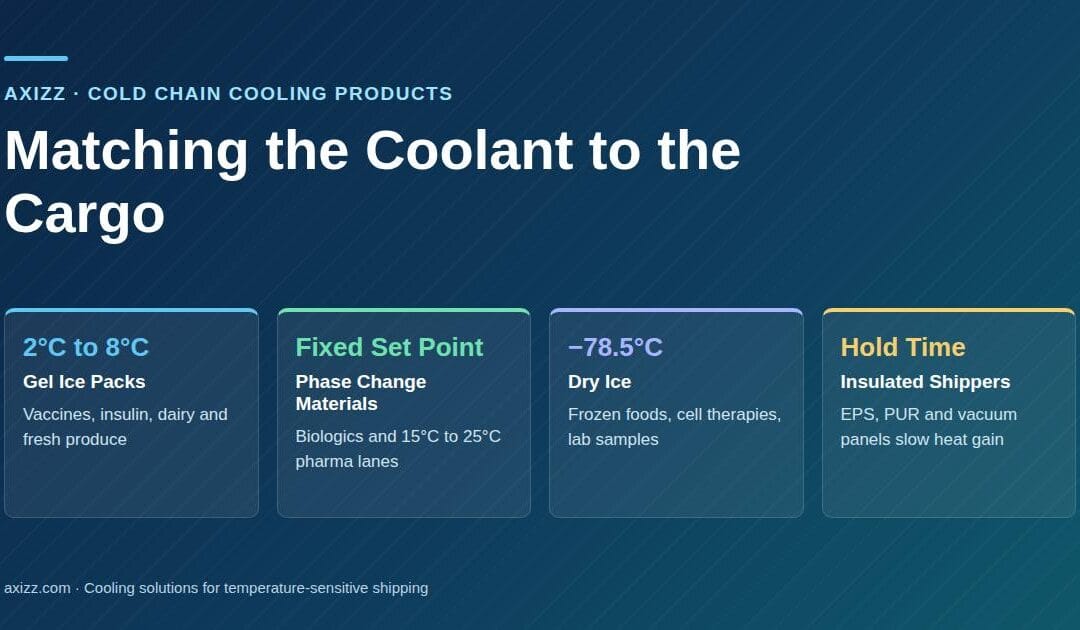
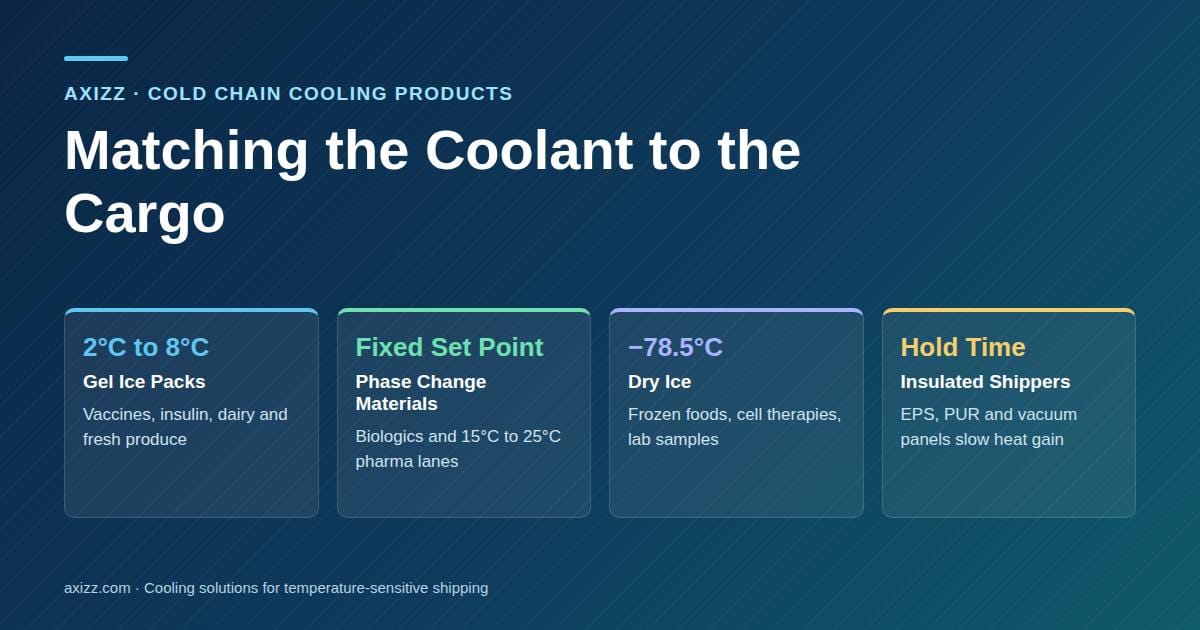
They absorb the heat that leaks into a package and hold the product at a target temperature for a set amount of time. Gel ice packs cover chilled shipments at 2°C to 8°C, phase change materials hold a precise set point, dry ice keeps frozen goods at −78.5°C, and insulated shippers slow heat gain so the coolant lasts longer.
What Are Cold Chain Cooling Products?
A cold chain is every step a product passes through while it has to stay cold: storage, loading, trucking, air freight, sorting hubs and final delivery. Refrigerated rooms and reefer trucks handle part of that journey. Cold chain cooling products handle the rest. They need no power, travel inside the box, and cover the gaps where active refrigeration is not available.
Almost every shipment pairs two things: a coolant that absorbs heat and an insulated container that slows heat coming in. The right combination depends on the product’s temperature range, how long it will be in transit and the weather it will face on the way.
The Main Types of Cold Chain Cooling Products
Gel Ice Packs
Gel packs hold a water-based gel that freezes and thaws more slowly than plain ice. They don’t leak meltwater, they can be refrozen and reused, and they suit the 2°C to 8°C (36°F to 46°F) chilled range that covers most vaccines, insulin, dairy, fresh produce and meal kits. For a deeper look, see how gel ice packs improve cold chain reliability.
Phase Change Materials (PCMs)
PCMs are engineered to freeze and melt at a specific temperature, such as 5°C or 22°C. While they change phase they hold that temperature steady, so they give tighter control than standard gel. That makes them a strong fit for biologics and controlled room temperature (15°C to 25°C) pharmaceutical lanes.
Dry Ice
Dry ice is solid carbon dioxide at −78.5°C. It sublimates straight into gas, so there is no liquid mess, and it is the go-to choice for frozen food, cell and gene therapies and clinical samples. It needs vented packaging and is regulated as a dangerous good for air transport.
Insulated Shippers and Box Liners
Expanded polystyrene (EPS), polyurethane (PUR) and vacuum insulated panels (VIPs) don’t create cold. They control how fast heat reaches the product. Better insulation means fewer coolant packs, a lighter parcel and a longer hold time.
| Cooling product | Typical temperature | Best for | Reusable |
|---|---|---|---|
| Gel ice packs | 2°C to 8°C (chilled) or frozen | Vaccines, insulin, dairy, produce, meal kits | Yes |
| Phase change materials | Fixed set point (for example 5°C or 22°C) | Biologics, controlled room temperature drugs | Yes |
| Dry ice | −78.5°C | Frozen food, cell therapies, lab samples | No |
| Insulated shippers | Works with any coolant | Every shipment that needs a longer hold time | Often |
6 Ways Cold Chain Cooling Products Are Shaping Logistics
1. Protecting Product Quality and Patient Safety
Many vaccines must stay between 2°C and 8°C, and the CDC notes that exposure outside the recommended range can reduce potency without any visible change. Reliable cooling products are the difference between a dose that works and one that silently fails.
2. Cutting Waste and Cost
Every rejected shipment means lost product, reshipping fees and unhappy customers. Consistent coolants and insulation reduce temperature excursions, which directly lowers write-offs. We cover this in more detail in how cooling products help reduce product waste.
3. Making Compliance Easier
Pharma shippers follow Good Distribution Practice (GDP) rules that expect proof of temperature control. Standardized pack-outs using the same gel packs, the same box and the same conditioning steps give repeatable results that are easy to validate and document with data loggers.
4. Powering E-Commerce and Last-Mile Delivery
Meal kits, online pharmacies and direct-to-consumer food brands all ship chilled parcels to homes through ordinary carrier networks. Lightweight gel packs and compact insulated liners make that possible without a refrigerated truck. Read more about cold chain packaging in e-commerce deliveries.
5. Extending the Reach of Global Trade
Longer hold times let shipments survive multi-day routes, customs delays and remote destinations such as rural clinics. Well-designed cold chain packaging turns a two-day window into a much safer margin.
6. Supporting Sustainability Goals
Reusable gel packs, recyclable liners and right-sized boxes reduce landfill waste, coolant use and freight weight. Many companies now run return programs so shippers and packs are used again instead of thrown away.
Industries That Depend on Cold Chain Cooling Products
- Pharmaceuticals and biologics: vaccines, insulin, specialty drugs and clinical trial supplies. See why cooling products matter for medical transport.
- Food and beverage: seafood, meat, dairy, fresh produce, meal kits and chocolate.
- Healthcare and diagnostics: blood samples, test kits and lab specimens.
- Chemicals and specialty materials: adhesives, reagents and other heat-sensitive compounds.
- Floral and horticulture: cut flowers and live plants that wilt in heat.
How to Choose the Right Cold Chain Cooling Products
- Confirm the required range. Chilled (2°C to 8°C), frozen, or controlled room temperature each need a different coolant.
- Map the full transit time. Add a buffer of at least a day for delays and weekend holds.
- Plan for the season. Summer and winter usually need different pack-outs.
- Match insulation to the route. Longer or hotter routes justify thicker walls or VIPs.
- Condition packs correctly. Don’t place frozen gel packs directly against 2°C to 8°C products, since they can freeze them. Use a barrier or refrigerated packs.
- Test before you scale. Run a trial shipment with a data logger to confirm the hold time.
Our guide on temperature-controlled shipping walks through these steps in more depth.
Trends Shaping the Future of Cold Chain Cooling
The next wave of cold chain cooling products is smarter and greener. Low-cost IoT data loggers now report temperature in real time, PCMs are moving from niche pharma use into mainstream shipping, and non-toxic, plant-based gels are replacing older formulas. Read more about the growing role of cooling technology in supply chains.
Frequently Asked Questions
What are cold chain cooling products?
They are passive coolants and insulated packaging, such as gel ice packs, phase change materials, dry ice and insulated shippers, that keep temperature-sensitive goods within a safe range during storage and transport.
How long do gel ice packs keep a shipment cold?
It depends on the number and size of packs, the insulation and the outside temperature. A well-designed insulated shipper can hold a chilled range from about 24 hours to several days.
Are gel ice packs better than regular ice?
For shipping, yes. Gel packs don’t leak water, hold temperature longer, keep their shape and can be reused many times.
Can gel ice packs be used to ship vaccines and medicine?
Yes, when they are conditioned correctly for the 2°C to 8°C range and separated from the product so nothing freezes. Always follow the manufacturer’s storage guidance.
What is the difference between gel packs and phase change materials?
Standard gel packs are water-based and work around 0°C. Phase change materials are formulated to hold a specific set point, such as 5°C or 22°C, which gives tighter temperature control.
Are cold chain cooling products reusable?
Gel ice packs, PCMs and many insulated shippers are reusable. Dry ice is single use because it turns into gas.
Final Thoughts
Cold chain cooling products have moved from a packing afterthought to a core part of logistics strategy. The right coolant and insulation protect product quality, cut waste, simplify compliance and open up new delivery models. Browse Axizz gel ice packs and cooling products or contact our team for help choosing the right setup for your shipments.