
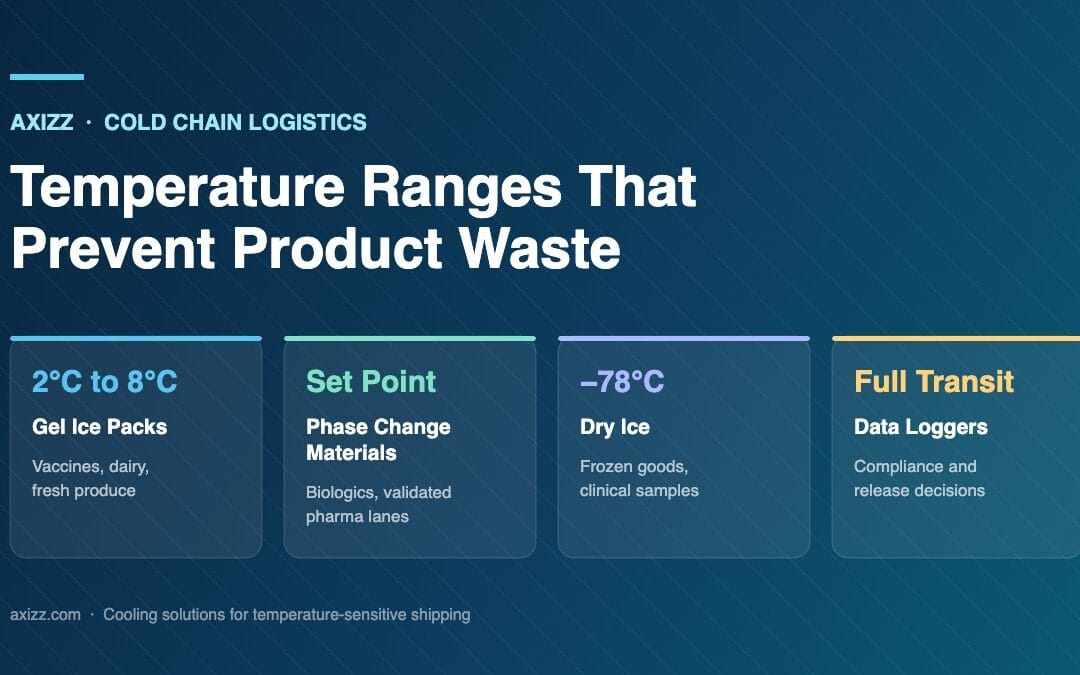
Cold chain logistics works on a simple rule: a temperature-sensitive product has to stay inside its safe range from the moment it leaves the facility until it reaches the end user. Cooling products such as gel ice packs, insulated shippers, phase change materials and temperature indicators hold that range steady during transit. That is how businesses reduce product waste at the source instead of writing off damaged stock after delivery.
Quick Answer: How Do Cooling Products Reduce Product Waste?
Cooling products reduce waste in cold chain logistics by absorbing heat that enters a shipment, slowing temperature rise, and buying enough stable hours to cover the full transit window. A correctly packed insulated shipper with the right coolant can hold 2°C to 8°C for 24 to 96 hours, which keeps vaccines, food, dairy, seafood and lab samples inside spec and prevents the spoilage that causes most cold chain losses.
Why Product Waste Happens in the Cold Chain
Most cold chain losses are not caused by one dramatic failure. They come from small gaps that add up across a route. According to the Food and Agriculture Organization, roughly 14 percent of the world’s food is lost between harvest and retail, and weak temperature control is one of the biggest contributors. In healthcare, the World Health Organization has long flagged cold chain breaks as a leading cause of vaccine wastage.
The common failure points look like this:
- Loading and unloading delays. A pallet sitting on a warm dock for 40 minutes can undo hours of refrigeration.
- Under-packed coolant. Packing for a 24 hour trip when the carrier actually needs 48 hours.
- Wrong coolant type. Using a chilled pack for frozen goods, or dry ice for a product that cannot be frozen.
- Poor insulation. Thin or single-wall boxes that let ambient heat in from every side.
- Last-mile exposure. Parcels left in hot vehicles or on doorsteps during the final hour of delivery.
- No visibility. Without a monitor, nobody knows a breach happened until the customer complains.
Each of these is a packaging and planning problem, which means each one is fixable before the shipment ever moves. For a deeper look at the process side, see our guide on why temperature-controlled shipping is essential for modern supply chains.
The Cooling Products That Do the Work
Gel Ice Packs
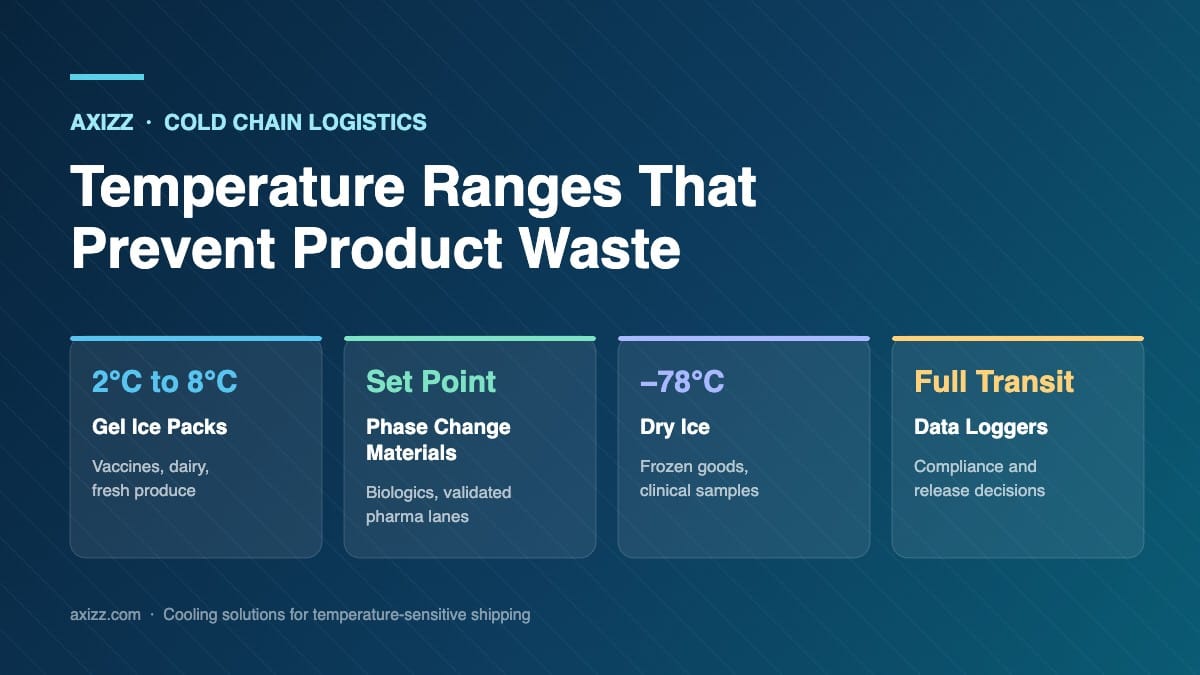
Gel packs are the workhorse of chilled shipping. They freeze solid, then absorb heat slowly as they thaw, which keeps a box near the 2°C to 8°C range used for most pharmaceuticals and fresh food. Reusable versions cut packaging spend over time and reduce single-use waste, which matters for high-volume shippers. We covered the commercial case in detail in the benefits of using reusable gel ice packs.
Insulated Shippers and Thermal Liners
Insulation does not create cold, it slows heat transfer. EPS coolers, polyurethane panels and foil thermal liners trap the cold energy your coolant provides so it lasts longer. Pairing a good liner with fewer gel packs often outperforms stuffing extra packs into a plain corrugated box, and it costs less to ship because the parcel weighs less.
Phase Change Materials (PCM)
PCMs are engineered to freeze and melt at a specific temperature, such as 5°C or minus 21°C, rather than at 0°C like water. That gives tighter control for sensitive biologics where both overheating and accidental freezing ruin the product. For validated pharmaceutical lanes, PCM is usually the safer choice.
Dry Ice
Dry ice sublimates at minus 78.5°C and is the standard for frozen shipments, clinical samples and some vaccines. It needs vented packaging and correct hazardous goods labeling, so it suits controlled lanes rather than general e-commerce.
Temperature Indicators and Data Loggers
Coolant protects the product. Monitoring protects the decision. A single-use indicator or a reusable logger tells the receiver whether the shipment stayed in range, so good stock is not thrown away out of caution and bad stock is not sold by mistake. Both outcomes cut waste.
| Cooling Product | Typical Range | Hold Time | Best For |
|---|---|---|---|
| Gel ice packs | 2°C to 8°C | 24 to 72 hours | Fresh food, dairy, chilled pharma, meal kits |
| Phase change materials | Set point, e.g. 5°C or minus 21°C | 48 to 120 hours | Vaccines, biologics, validated lanes |
| Dry ice | Around minus 78°C | 24 to 48 hours per charge | Frozen goods, clinical samples, ice cream |
| Insulated shippers | Passive, extends coolant life | Depends on coolant | Every cold shipment |
| Data loggers and indicators | Monitoring only | Full transit | Compliance, claims, release decisions |
Where This Matters Most
Food and Grocery
Fresh produce, seafood, dairy and prepared meals lose shelf life fast once they warm up. Even a short excursion shortens the sell-by window, so a product that arrives technically edible may still be unsellable. Proper coolant packing protects both safety and shelf life, which is why food delivery companies depend on cooling products for every route.
Pharmaceuticals and Vaccines
Most refrigerated vaccines require 2°C to 8°C storage, as outlined in the CDC vaccine storage and handling toolkit. A single breach can force a whole consignment to be discarded, and the unit values are high. More on this in the importance of cooling products in pharmaceutical distribution.
Laboratory and Diagnostic Samples
A blood or tissue sample that warms up is not just wasted product, it is a repeat collection, a delayed diagnosis and an unhappy patient. Cooling products protect the sample and the timeline.
The Business Case for Getting This Right
Reducing spoilage is the obvious win, but the downstream savings are usually larger:
- Fewer replacement shipments. Every reship doubles freight, labor and packaging cost on a sale you already made.
- Lower claims and disputes. Logger data settles arguments with carriers and customers quickly.
- Cleaner compliance record. Documented temperature control supports GDP, HACCP and FDA expectations.
- Better customer retention. One spoiled delivery costs far more in lifetime value than the coolant would have cost.
- Less packaging waste. Reusable gel packs and shippers reduce both cost per shipment and landfill volume.
How to Choose the Right Cooling Setup
- Define the product’s real range. Chilled, frozen or controlled ambient, plus whether freezing damages it.
- Measure worst-case transit time. Take your longest realistic route and add a safety buffer, not your average route.
- Check the ambient profile. Summer lanes and tropical destinations need more coolant than the same route in winter.
- Match insulation to coolant. Better insulation often means less coolant, lighter parcels and lower freight cost.
- Test before you scale. Run a loaded shipment with a data logger and confirm the profile holds end to end.
- Document the pack-out. A written, repeatable packing standard is what keeps results consistent across staff and seasons.
If you are still comparing options, our guide on cold chain packaging and our overview of how cold chain solutions ensure safe transportation walk through the trade-offs.
Frequently Asked Questions
What is cold chain logistics?
Cold chain logistics is the end-to-end process of storing and transporting temperature-sensitive products within a defined temperature range. It covers refrigerated storage, insulated packaging, coolants, vehicles and monitoring from the point of origin to the final delivery.
How do cooling products reduce product waste?
They absorb incoming heat and slow the rate at which a shipment warms up, keeping the product inside its safe range for the full transit window. Because most cold chain waste is caused by temperature excursions rather than physical damage, controlling temperature removes the main cause of loss.
How long do gel ice packs stay cold in a shipment?
In a properly insulated shipper, frozen gel packs typically hold chilled conditions for 24 to 72 hours. The exact result depends on pack quantity and weight, insulation quality, void fill, outside temperature and how often the box is opened.
Which is better for cold chain shipping, gel packs or dry ice?
Gel packs are better for chilled products that must not freeze, such as fresh food and most refrigerated pharmaceuticals. Dry ice is better for frozen products and clinical samples that need deep-freeze conditions, but it requires vented packaging and hazardous goods handling.
Do reusable cooling products actually save money?
Yes, for repeat lanes and returnable packaging programs. Reusable gel packs and shippers cost more per unit up front, but the cost per shipment drops sharply after a few cycles, and they cut disposal volume at the receiving end.
How can a business tell if its cold chain is failing?
Look for rising spoilage claims, short shelf life complaints, inconsistent arrival condition between routes, and shipments delivered without temperature data. Adding data loggers to a sample of shipments usually exposes the weak leg of the route within a few weeks.
Final Thoughts
Product waste in cold chain logistics is rarely a mystery. It is the predictable result of packing for the average case instead of the worst case. The right combination of gel ice packs, insulated shippers, phase change materials and monitoring turns temperature control from a hope into a measurable process. That protects margin, protects compliance and protects the customer relationship on every shipment.
Axizz supplies gel ice packs and cooling solutions built for commercial cold chain use. Contact our team to match the right coolant and packaging to your routes, or read choosing the right cooling solution for your business to narrow it down yourself.