
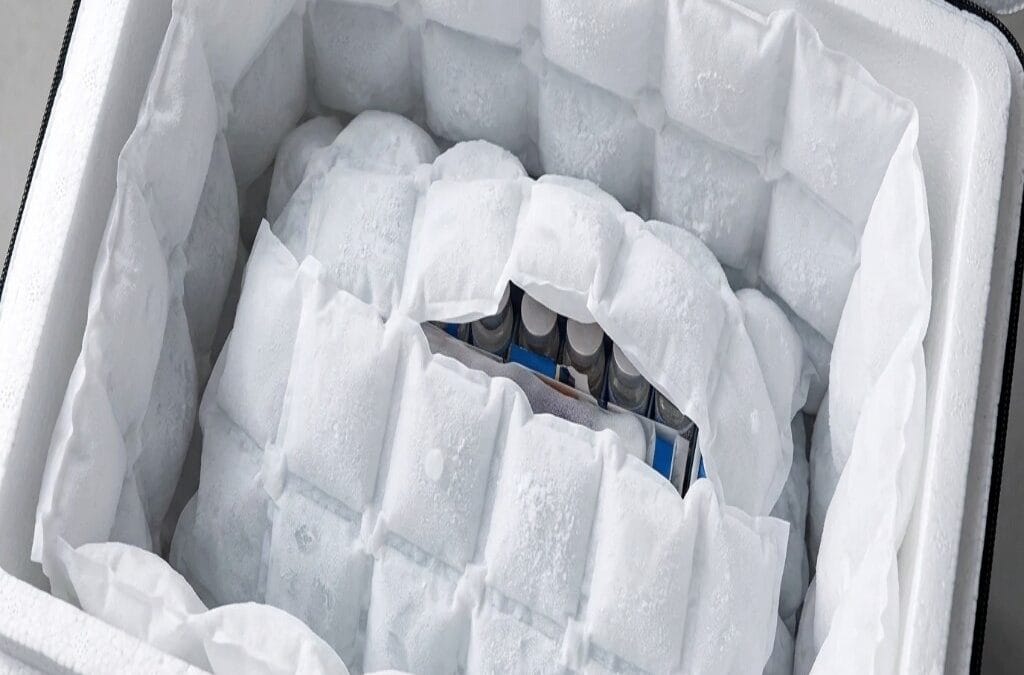
Cooling solutions for food delivery are the insulated packaging, gel ice packs, refrigerants and temperature monitors that hold perishable food inside a safe range from the kitchen to the customer’s door. They matter because chilled food has roughly two hours outside refrigeration before bacteria reach unsafe levels, and that window drops to one hour once the outside temperature passes 90°F (32°C).
For meal kit brands, grocery couriers, caterers and specialty food shippers, cooling is not packaging overhead. It is the part of the order the customer actually judges: a salad that arrives crisp, a steak that arrives cold, a dessert that has not collapsed. This guide covers the main types of cooling solutions for food delivery, how to match one to your route length, and the handling practices that keep every box in range.
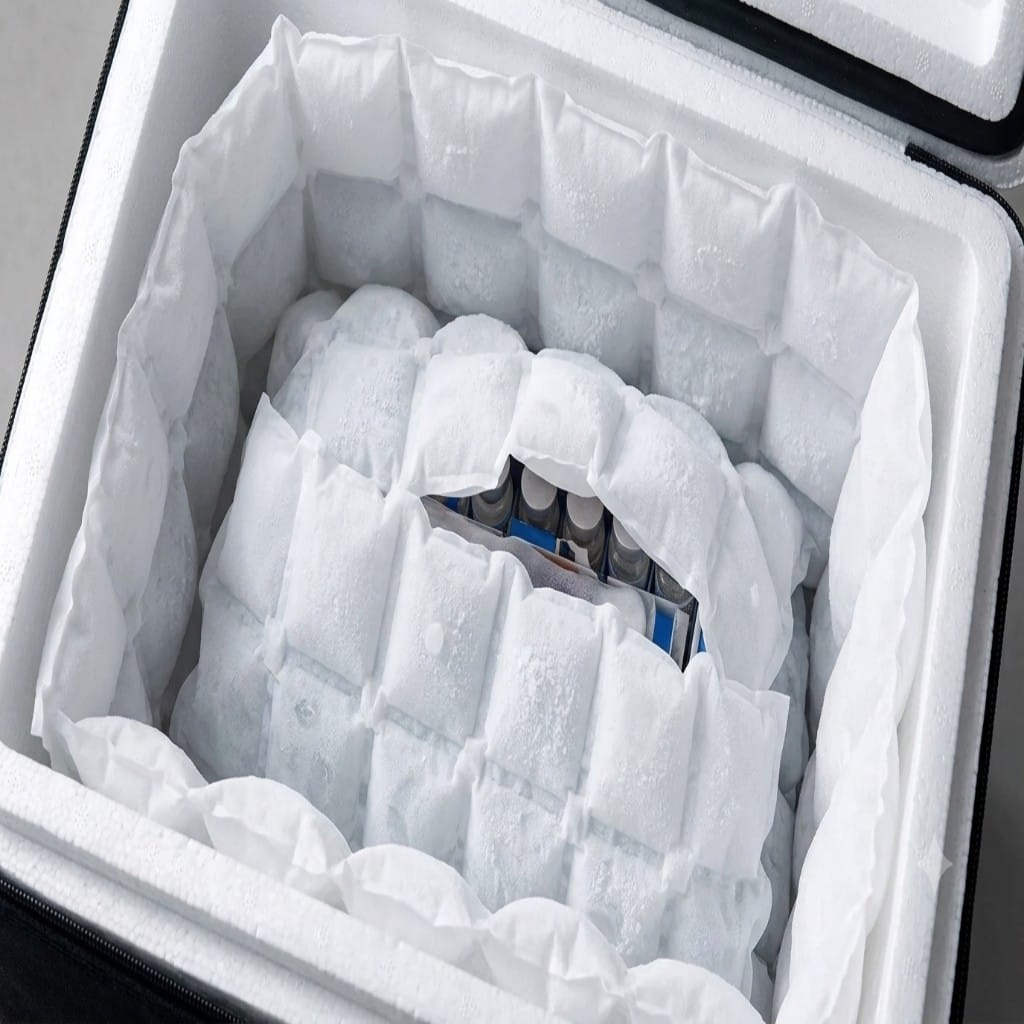
What Are Cooling Solutions for Food Delivery?
A cooling solution is a complete system, not a single product. Four layers work together, and weakening any one of them undoes the rest:
- Insulation – an insulated liner, tote, cooler bag or shipping box that slows heat transfer from the outside environment.
- Refrigerant – gel ice packs, dry ice or phase change material that absorbs the heat that does get in.
- Packaging and sealing – vacuum seals, liners and void fill that stop leaks, cross-contamination and warm air pockets.
- Monitoring – temperature indicators or data loggers that prove the load stayed in range instead of assuming it did.
Most delivery failures trace back to a missing layer rather than a faulty product. A strong gel pack in a thin cardboard box will not hold, and a premium insulated shipper with too little refrigerant will not either. Effective cooling solutions for food delivery only work when all four layers are sized together, which is the same logic behind every well-built cold chain packaging setup.
Why Temperature Control Decides Food Safety
The 40°F to 140°F Danger Zone
The USDA defines 40°F to 140°F (4°C to 60°C) as the danger zone, the range in which bacteria such as Salmonella and Listeria multiply fastest. Cold food needs to stay at or below 40°F, and hot food at or above 140°F. Anything that sits between those numbers for more than two hours is considered unsafe to serve. Delivery is the hardest part of the chain to control because the food leaves refrigeration, sits in a courier bag, waits in a car and then waits again on a doorstep. That gap is exactly what cooling solutions for food delivery are built to cover.
What a Temperature Failure Actually Costs
A single warm box is rarely a single loss. It usually becomes a refund, a replacement shipment, a one-star review that outlives the order, and in regulated categories a reportable incident. Brands that ship perishables nationally treat cooling spend as insurance against that chain reaction, which is the same reason temperature-controlled shipping has become standard rather than premium.
Types of Cooling Solutions for Food Delivery
| Method | Typical hold time | Best for |
|---|---|---|
| Gel ice packs | 4–48 hours | Meal kits, groceries, local and 1–2 day shipping |
| Insulated liners and shippers | Extends any refrigerant | Every perishable shipment |
| Dry ice | 12–48 hours | Frozen food, ice cream, seafood |
| Phase change material (PCM) | 24–96 hours | Tight ranges, pharma-grade and premium food |
| Refrigerated bags and vehicles | Continuous | High-volume routes and catering |
Gel Ice Packs
Gel packs are the default for most food delivery operations. They are reusable, non-hazardous, flexible enough to sit against product, and they do not leave puddles the way loose ice does. Freeze them solid for at least 12 hours, size them to the box rather than the product, and place them above and beside the food, since cold air falls. Our breakdown of how gel ice packs improve food safety during transportation covers placement in more detail.
Insulated Liners, Totes and Shippers
Insulation buys time. Foil-lined bubble liners are light and inexpensive, moulded EPS and EPP shippers hold longer, and recycled paper or plant-based liners give similar performance with a better end-of-life story. The right pick depends on transit time, not on what looks most premium on the shelf.
Dry Ice
Dry ice holds product frozen at −109°F (−78°C) and is the standard for ice cream and seafood. It is also a regulated material: packaging must vent, carriers require hazard labelling, and handlers need gloves. Use it where frozen is the requirement, not simply because colder feels safer.
Phase Change Materials
PCM packs are engineered to hold one specific temperature, such as 5°C or −15°C, rather than simply staying cold. That makes them the choice when a product can be ruined by freezing as easily as by warming. They cost more per unit and pay for themselves on long routes and high-value loads.
Refrigerated Bags and Vehicles
Active cooling removes the hold-time limit entirely, which suits catering, grocery routes and any operation running fixed daily volume. The trade-off is capital cost and maintenance, so most businesses run active cooling on the vehicle and passive cooling inside each box.
How to Choose the Right Cooling Solutions for Food Delivery
Work through these six questions before you buy any cooling solutions for food delivery:
- Target temperature. Chilled, frozen or a narrow band? This rules out most options immediately.
- Worst-case transit time. Plan for the delayed delivery, not the average one, and add a safety margin of at least 25%.
- Ambient conditions. A summer route in Arizona and a winter route in Ohio need different refrigerant loads.
- Box size and fill ratio. Half-empty boxes warm faster. Right-size the packaging or add void fill.
- Handling reality. If couriers stack boxes, choose rigid shippers and leak-proof packs.
- Cost per delivery. Compare reusable and single-use over 50 cycles, not over one.
A practical rule of thumb: under 4 hours, an insulated bag with one gel pack is usually enough. For 4 to 24 hours, use an insulated shipper with sized gel packs. Beyond 24 hours, move to PCM or dry ice and validate the setup with a data logger before you ship live orders.
Best Practices That Keep Food in Range
- Pre-chill the product and the packaging. Refrigerant is there to hold temperature, not to pull it down.
- Freeze gel packs flat and fully solid, and keep a rotating stock so none go out soft.
- Place packs above and around the food, with a barrier layer for anything freeze-sensitive.
- Fill dead space. Air is the enemy of hold time.
- Separate raw and ready-to-eat items, following the FDA Food Code guidance on cross-contamination.
- Stage orders so packed boxes leave within minutes, not hours.
- Log temperatures on a sample of shipments each week and act on outliers.
- Tell the customer on the label to refrigerate on arrival. Delivery ends at the door; food safety does not.
Sustainability and Cost
Single-use foam is cheap per shipment and expensive in brand terms. Reusable gel packs, recyclable paper liners and curbside-recyclable shippers now match foam closely on performance, and customers increasingly notice the difference. Over a full season, reusable cooling solutions for food delivery also cut the per-delivery cost, which is why many operators switch for margin reasons before sustainability ones. We compared the numbers in our guide to the benefits of reusable cooling solutions for businesses.
Frequently Asked Questions
What are the best cooling solutions for food delivery?
For most chilled food, reusable gel ice packs inside an insulated liner or shipper are the best cooling solutions for food delivery. They are reusable, leak-resistant, safe to handle and hold 4 to 48 hours depending on pack weight. Frozen products need dry ice, and narrow-tolerance products need phase change material. Match the cooling solutions for food delivery to your longest realistic transit time, not your average one.
How long can food stay safe during delivery without refrigeration?
Two hours at normal room temperature, and one hour above 90°F (32°C). Proper insulation plus refrigerant extends that safe window to a full day or more.
How many gel ice packs do I need per box?
A common starting point is about 1 pound of frozen gel per 4 to 6 pounds of chilled product for same-day or next-day delivery, increased for hot weather or longer transit. Validate with a data logger rather than relying on the estimate alone.
Are gel ice packs safe around food?
Yes. Food-grade gel packs use non-toxic gel in sealed, puncture-resistant film and are designed for direct contact with sealed food packaging. Discard any pack that has split rather than reusing it.
Can I reuse gel packs from deliveries I receive?
Yes, if the pack is intact and clean. Wipe it down, refreeze it flat, and replace it once the film softens, clouds or shows any seam damage.
Building a Delivery Experience Customers Trust
Reliable cooling solutions for food delivery protect three things at once: food safety, product quality and the reputation that brings the next order. Match the refrigerant to your real transit time, insulate properly, pack with intent and measure the result. Do that consistently and temperature stops being a risk you manage order by order. Explore the full range of Axizz cooling products to build a setup that fits your delivery model, or read more on reliable temperature control in food distribution.