
Healthcare cold chain packaging is the insulated shipping system (an outer box, insulation, refrigerants like gel ice packs, and a temperature monitor) that keeps vaccines, insulin, biologics, and lab samples within a safe temperature range from the manufacturer to the patient. For most vaccines and many biologics, that range is 2°C to 8°C (36°F to 46°F).
When the packaging works, nobody notices. When it fails, a shipment worth thousands of dollars can become unusable in a few hours, and a clinic, pharmacy, or patient waits longer for care. This guide explains how it works, which temperature ranges matter, and seven ways it protects global healthcare supply chains.
Key Takeaways
- Most vaccines, insulin, and many biologics must stay between 2°C and 8°C during storage and transit.
- A 2019 IQVIA analysis estimated that temperature-controlled logistics failures cost the biopharma industry about $35 billion a year.
- Every healthcare cold chain packaging system has four parts: an outer shipper, insulation, a refrigerant, and temperature monitoring.
- Gel ice packs are the most common refrigerant for 2°C to 8°C shipments because they are reusable, leak-resistant, and easy to condition.
- Freezing is as big a risk as heat. Many refrigerated vaccines lose potency if they freeze.
- Validated pack-outs, correctly conditioned gel packs, and data loggers prevent most temperature excursions.
What Is Healthcare Cold Chain Packaging?
Healthcare cold chain packaging is any packaging system designed to hold a medical product at its labeled temperature for a set number of hours while it moves between locations. It sits inside the wider cold chain, which also includes refrigerated warehouses, reefer trucks, and clinic storage units. The packaging is the part that travels with the product, so it has to work on its own while the box sits on a loading dock, in a cargo hold, or in a delivery van.
A well-designed system is usually “qualified” or “validated.” That means it has been tested to prove it holds the right temperature for a stated time, such as 48 or 72 hours, under both summer and winter conditions. For a broader overview, see our guide to cold chain packaging.
Why Temperature Control Matters in Healthcare Supply Chains
Medicines are sensitive in ways that are easy to miss. Heat can break down the proteins in biologics and vaccines. Freezing can be just as damaging, and the CDC’s vaccine cold chain guidance warns that exposure to temperatures outside the recommended range can reduce vaccine potency, often without any visible change.
The cost adds up fast. A 2019 IQVIA analysis estimated that failures in temperature-controlled logistics cost biopharma companies around $35 billion every year. The World Health Organization has also estimated that up to half of vaccines may be wasted globally, with temperature control and logistics among the main causes, as reported by the World Economic Forum.
Global distribution raises the stakes. One shipment might pass through a manufacturer, an airport, customs, a regional distributor, and a last-mile courier before it reaches a hospital. Every handoff is a chance for the temperature to drift, which is why temperature stability is so critical for pharmaceutical products.
Temperature Ranges for Common Medical Products
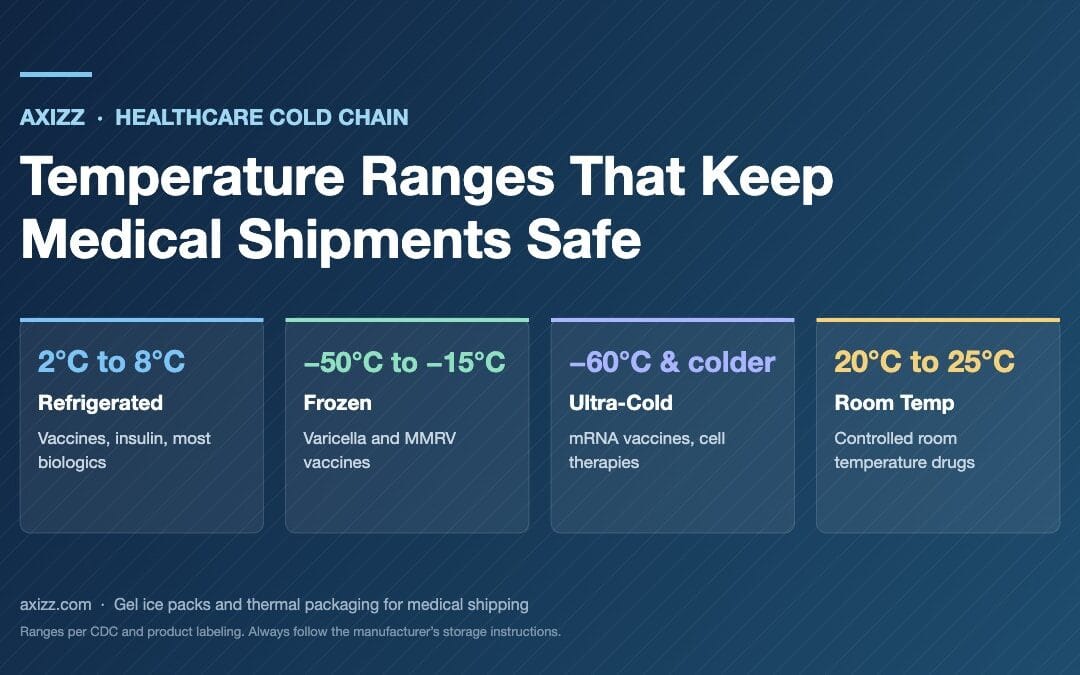
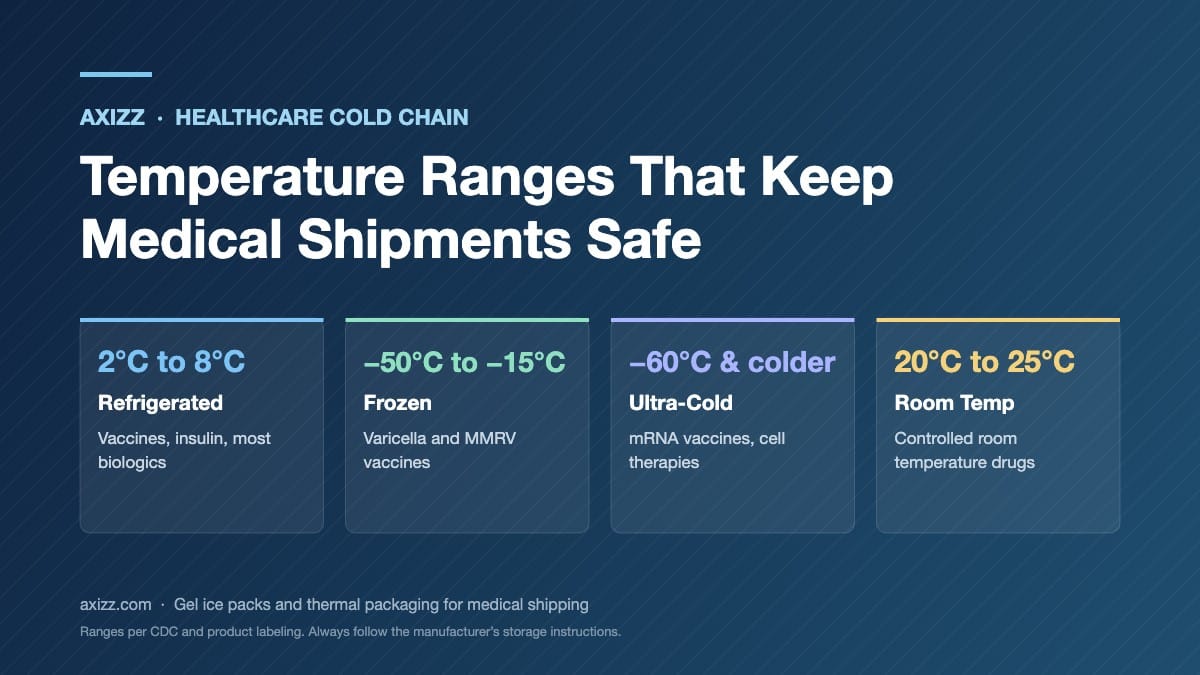
Each product has its own labeled range. The table below shows common ranges and the refrigerants typically used to hold them.
| Product type | Typical range | Common refrigerant |
|---|---|---|
| Most vaccines, insulin, many biologics | 2°C to 8°C (36°F to 46°F) | Conditioned gel ice packs, phase change materials |
| Frozen vaccines (such as varicella and MMRV) | -50°C to -15°C (-58°F to 5°F) | Frozen gel packs, dry ice |
| Ultra-cold products (some mRNA vaccines, cell and gene therapies) | -60°C or colder | Dry ice, liquid nitrogen dry shippers |
| Controlled room temperature drugs | 20°C to 25°C (68°F to 77°F) | Room-temperature conditioned gel packs, phase change materials |
| Clinical and lab samples | Varies by test: refrigerated, frozen, or ambient | Gel ice packs or dry ice |
These ranges are general. Always follow the manufacturer’s label or package insert for the specific product you are shipping.
The 4 Core Components of a Healthcare Cold Chain Packaging System
1. Outer Shipper
A corrugated box protects everything inside from crushing, moisture, and rough handling. It also carries labels such as “Keep Refrigerated” or “Do Not Freeze” so every handler knows what they are dealing with.
2. Insulation
Insulation slows heat transfer. Common options include expanded polystyrene (EPS) coolers, polyurethane foam, vacuum insulated panels (VIPs) for long routes, and reflective thermal liners for lighter parcels. Products like our THERMAPACK thermal shipping envelopes and covers add a protective layer around smaller shipments.
3. Refrigerant
The refrigerant does the actual work of holding temperature. Gel ice packs are the standard choice for refrigerated shipments, phase change materials (PCMs) are used when a product needs a tight set point, and dry ice handles frozen and ultra-cold loads. For frozen lanes, THERMAPACK -10°F/-23°C gel ice packs are built to hold lower temperatures than standard packs.
4. Temperature Monitoring
Data loggers and temperature indicators record what happened during transit. They give the receiving pharmacy, hospital, or lab proof that the product stayed in range, which is often required before the product can be released for use.
7 Proven Ways Healthcare Cold Chain Packaging Protects Global Supply Chains
1. Keeps Vaccines Potent From Factory to Clinic
Vaccines are the classic cold chain product. Reliable packaging keeps them in range through every leg of the trip, so the dose a nurse gives a patient works the way it was designed to.
2. Protects High-Value Biologics and Specialty Drugs
A single box of biologics, oncology drugs, or fertility medications can be worth tens of thousands of dollars. Good packaging protects that investment and prevents expensive reshipments and treatment delays.
3. Supports Regulatory Compliance
Distributors are expected to follow Good Distribution Practice rules such as the EU GDP guidelines, along with standards like USP <1079> in the United States. Qualified packaging and clean temperature records make audits and product release much easier.
4. Makes Remote and Last-Mile Delivery Possible
Rural clinics and field health programs often have no refrigerated trucks. Many qualified shippers packed with conditioned gel ice packs are designed to hold temperature for 48 to 96 hours, which bridges the gap where powered refrigeration is not available.
5. Reduces Product Waste and Cost
Every excursion you prevent is a product you do not have to destroy and replace. We cover this in more detail in how cooling products help reduce waste in cold chain logistics.
6. Keeps Lab Samples and Clinical Trial Materials Reliable
Blood samples, diagnostic specimens, and investigational drugs all depend on stable temperatures. A sample that warms up in transit can give inaccurate results or force a patient to come back for a repeat draw.
7. Supports Home Healthcare and Direct-to-Patient Shipping
More patients now receive insulin, injectable medications, and specialty therapies at home. Compact healthcare cold chain packaging makes it possible to ship these products straight to a patient’s door without losing temperature control. You can learn more about temperature-controlled packaging for pharmaceutical shipping in our related guide.
Why Gel Ice Packs Are the Go-To Refrigerant for Medical Shipments
Gel ice packs hold cold longer and more evenly than loose ice, they do not leave water in the box when they thaw, and most are reusable. They are also easy to pre-condition to the right temperature, which matters for products that must never freeze. That combination makes them a core part of healthcare cold chain packaging. For a deeper comparison, read why gel ice packs are better than traditional ice and how gel ice packs enhance cold chain reliability.
Axizz supplies gel ice packs in multiple sizes, including THERMAPACK gel ice pack refrigerants for standard refrigerated lanes and the CRYOPAK flexible ice blanket, which wraps around irregular shapes.
Gel Ice Packs vs. Dry Ice vs. Phase Change Materials
Each refrigerant fits a different job. This quick comparison helps you pick the right one for your medical cold chain packaging.
| Refrigerant | Best for | Main advantages | Watch out for |
|---|---|---|---|
| Gel ice packs | Refrigerated (2°C to 8°C) and frozen shipments | Reusable, leak-resistant, low cost, and easy to condition for different ranges | Can freeze sensitive products if packed straight from the freezer |
| Phase change materials (PCMs) | Tight set points such as 2°C to 8°C or 15°C to 25°C | Very stable temperature because they are designed to melt at a set point | Higher cost and careful conditioning needed |
| Dry ice | Frozen and ultra-cold shipments | Very cold at -78.5°C (-109.3°F) and leaves no liquid behind | Regulated as a dangerous good for air transport, needs venting, and is too cold for 2°C to 8°C products |
For most parcel-size refrigerated shipments, conditioned gel ice packs give the best balance of cost, reliability, and ease of use.
How to Choose the Right Healthcare Cold Chain Packaging
Choosing healthcare cold chain packaging comes down to three questions: what temperature does the product need, how long will it travel, and what conditions will it face on the way? These six steps help you narrow it down.
- Start with the product label. Note the required temperature range and whether the product can tolerate freezing.
- Map the full route. Add up transit time, handoffs, and customs checks. The pack-out should hold temperature longer than the longest realistic trip.
- Check the outside temperatures. A summer route through a hot airport hub needs a different setup than a winter route with freezing nights.
- Match insulation to the trip length. Thermal liners and envelopes suit short parcel trips, EPS coolers cover many 24 to 48 hour routes, and polyurethane or vacuum insulated panel shippers handle longer, high-value lanes.
- Choose and condition the refrigerant. Use gel ice packs or PCMs for refrigerated and room-temperature products, and frozen gel packs or dry ice for frozen loads.
- Validate the pack-out. Test the complete configuration against summer and winter temperature profiles, such as ISTA 7D or 7E, before you ship real product.
Best Practices for Packing Temperature-Sensitive Medical Shipments
These habits help any healthcare cold chain packaging program cut down on temperature excursions:
- Match the pack-out to the label. Choose insulation and refrigerant based on the product’s range and the longest realistic transit time.
- Condition gel packs correctly. Packs straight from a freezer can push a 2°C to 8°C product below freezing. Use refrigerated or properly conditioned packs, or add a buffer layer between frozen packs and the product.
- Pre-cool the shipper. If your validated process calls for it, store the empty cooler at the right temperature before packing.
- Fill empty space. Air gaps warm up faster. Use dunnage to keep products and packs from shifting.
- Add a data logger or indicator. Place it near the product, not against a gel pack, so it reads the product’s real temperature.
- Plan for delays. Avoid shipping late in the week and leave buffer time for customs and weekends.
- Use seasonal pack-outs. Summer and winter need different configurations to avoid overheating or freezing.
The Future of Healthcare Cold Chain Packaging
Three trends are shaping what comes next. Reusable shippers and refillable gel packs are cutting waste and cost per shipment. Real-time IoT trackers give shippers live temperature and location data instead of a report after delivery. And new cell and gene therapies are driving demand for ultra-cold solutions. For more on where the industry is heading, read the future of temperature-controlled packaging.
Frequently Asked Questions
What is healthcare cold chain packaging?
Healthcare cold chain packaging is an insulated shipping system that keeps medical products such as vaccines, insulin, biologics, and lab samples within their labeled temperature range during transport. It usually combines an outer box, insulation, refrigerants like gel ice packs, and a temperature monitor.
What is the difference between active and passive cold chain packaging?
Passive packaging uses insulation and refrigerants such as gel ice packs and needs no power. Active packaging uses powered, thermostat-controlled containers, mostly for large air cargo shipments. Most parcel-size healthcare shipments use passive packaging because it is lighter, cheaper, and easier to scale.
What temperature do vaccines need during shipping?
Most refrigerated vaccines must stay between 2°C and 8°C (36°F and 46°F). Frozen vaccines such as varicella are kept between -50°C and -15°C, and some mRNA vaccines need ultra-cold storage. Always check the manufacturer’s label.
How long can cold chain packaging keep medicine cold?
It depends on the insulation, the refrigerant, and the outside temperature. Basic insulated shippers typically hold 24 to 48 hours, while high-performance systems with vacuum insulated panels and phase change materials can hold 96 to 120 hours or more.
How is cold chain packaging tested?
Shippers are tested in climate chambers that mimic real summer and winter routes. ISTA 7D and ISTA 7E are common test standards for parcel shipments. A validated pack-out comes with a fixed configuration that states which refrigerants to use, how to condition them, and where to place them in the box.
Can you use regular ice to ship medicine?
It is not recommended. Loose ice melts into water, cools unevenly, and is hard to validate. Gel ice packs or phase change materials give more consistent, leak-free cooling.
Are gel ice packs safe for pharmaceutical shipping?
Yes. Quality gel ice packs are non-toxic, leak-resistant, and widely used in pharmaceutical cold chains. The key is conditioning them correctly so they do not freeze products that must stay above 0°C.
What is a temperature excursion?
A temperature excursion is any time a medical product is exposed to temperatures outside its labeled range, even for a short time. Because the damage is often invisible, every excursion should be recorded and reviewed by the manufacturer or a quality team before the product is used.
What should you do if a medical shipment arrives out of range?
Do not use or throw away the product right away. Store it at the correct temperature, label it “Do Not Use,” and contact the manufacturer or your quality team with the data logger readings so they can decide whether it is still usable.
Final Thoughts
Healthcare cold chain packaging does quiet but critical work. It keeps vaccines effective, protects expensive therapies, supports compliance, and gets medicine to patients who live far from a hospital. The right mix of insulation, refrigerant, and monitoring is often the difference between a safe delivery and a costly loss.
If you are building or upgrading a medical shipping program, contact the Axizz team or browse our gel ice pack range to find the right fit for your temperature needs.