
Businesses choose gel ice packs for cold chain transportation because they hold a steady temperature, ship without hazmat paperwork, and cost less per shipment than most alternatives. For companies moving vaccines, meal kits, seafood, lab samples or fresh flowers, that mix of reliability and simplicity is hard to beat.
Trust in the cold chain is earned one shipment at a time. A single warm box can mean a spoiled order, a refund, a failed audit or a lost customer. Below, we break down why gel packs have become the go-to refrigerant for so many shippers, where they fit best, and how to use them so every box arrives in range.
Key takeaways
- Gel packs absorb heat as they thaw, keeping the inside of an insulated shipper stable for 24 to 72 hours depending on the pack-out.
- Non-toxic gel packs are not regulated as hazardous materials, unlike dry ice.
- Reusable cold chain gel packs lower the cost per shipment and cut packaging waste.
- For 2-8°C pharmaceuticals, packs must be conditioned to the right temperature, not used straight from the freezer.
What Are Gel Ice Packs for Cold Chain Transportation?
A gel ice pack is a sealed, leak-resistant pouch filled with a water-based gel. You freeze or chill it, place it inside an insulated shipper with the product, and it slowly absorbs heat as it warms. Because the gel changes from solid to liquid at a set temperature, it works like a thermal battery that keeps the payload cold for the length of the trip. That is the core job of gel ice packs for cold chain transportation: absorb outside heat before it reaches the product.
Standard packs hold close to 32°F (0°C). Specialty formulas go colder, like our THERMAPACK™ -10°F/-23°C gel ice packs, which provide about 15% longer protection than standard packs. Others are chilled in a refrigerator instead of a freezer to protect products that must never freeze.
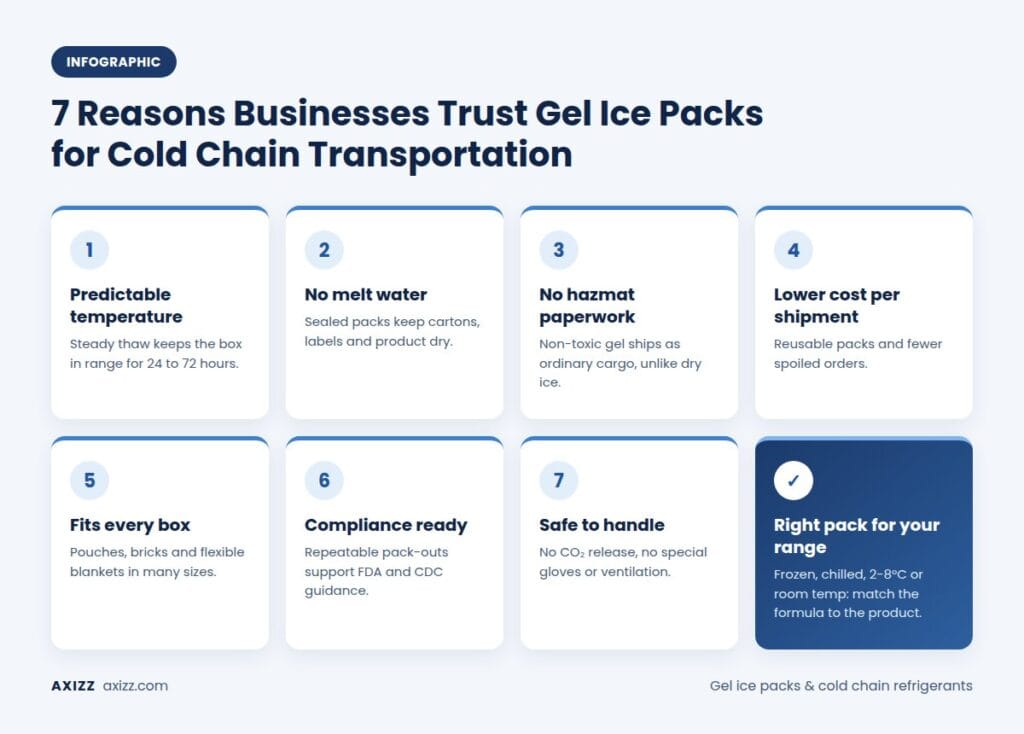
7 Reasons Businesses Trust Gel Ice Packs for Cold Chain Transportation
1. They Hold Temperature Predictably
Loose ice melts unevenly and leaves warm spots. A gel pack thaws at a steady rate, so the temperature curve inside the box stays flat. That predictability lets a shipper build a pack-out once, test it, and repeat it on thousands of orders. Most validated pack-outs are designed around 24, 48 or 72-hour transit windows.
2. No Melt Water, No Damaged Goods
When regular ice melts, it soaks cartons, smears labels and can contaminate food or packaging. Gel packs stay sealed from start to finish. The box arrives dry, the label still scans, and the product looks the way the customer expects. We cover this in more detail in why gel ice packs are better than traditional ice.
3. They Ship Without Hazmat Paperwork
Dry ice is regulated as a Class 9 hazardous material (UN1845), especially for air shipments. That means special marking, quantity limits and trained staff. Non-toxic gel packs for shipping travel as ordinary cargo. For a small team shipping every day, skipping that extra compliance step saves time and lowers the chance of a rejected package.
4. They Lower the Cost per Shipment
Temperature failures are expensive. The IQVIA Institute estimates the biopharma industry loses about $35 billion a year to failures in temperature-controlled logistics. Cold chain gel packs reduce that risk at a low unit cost, and because they are reusable, many businesses freeze and reuse the same packs across several cycles. Fewer spoiled shipments, fewer replacement orders and fewer support tickets add up fast.
5. There Is a Size and Format for Every Box
Cold chain gel packs come as small pouches, large bricks and flexible blankets that wrap around a product. Blanket styles like the CRYOPAK™ Flexible Ice Blanket mold around irregular items, while flat packs line the walls of an insulated shipper. Pair them with THERMAPACK™ thermal shipping envelopes for economical 24-hour shipments of food, plants and pharmaceuticals.
6. They Support Food and Drug Compliance
Regulators care about results. The FDA’s Sanitary Transportation rule requires adequate temperature controls for foods that need them, and the USDA advises keeping perishable food at 40°F or below to stay out of the temperature danger zone. A documented gel pack pack-out, backed by a temperature logger, gives auditors the proof they want and gives your team a repeatable process.
7. They Are Safer to Handle
Gel packs do not release carbon dioxide, do not need ventilation, and do not require insulated gloves the way dry ice does. Staff can pack them quickly without special training, and customers can reuse them at home.
Which Gel Pack Setup Fits Your Product?
The right pack-out depends on the temperature range your product needs. Use this table as a starting point, then test it with a data logger in real cold chain shipping conditions.
| Product range | Common products | Recommended setup | Watch out for |
|---|---|---|---|
| Frozen: 0°F (-18°C) or colder | Ice cream, frozen seafood, frozen meals | -10°F/-23°C gel packs, thick insulation (dry ice for deep frozen) | Too few packs in summer heat |
| Chilled: 33-40°F (1-4°C) | Meat, seafood, dairy, meal kits | Frozen gel packs above and around the product | Delicate items freezing on contact |
| Refrigerated: 36-46°F (2-8°C) | Vaccines, insulin, diagnostic kits | Conditioned gel packs or phase change materials with a buffer layer | Packs used straight from the freezer |
| Controlled room temp: 59-77°F (15-25°C) | Some medicines, chocolate, cosmetics | Refrigerated or room-temperature conditioned packs | Overcooling in winter |
For vaccines, the CDC advises against packing refrigerated vaccines with frozen gel packs because they can freeze the doses. It points to phase change materials conditioned between 4°C and 5°C (39°F and 41°F) instead. That is a smart rule for any product that is damaged by freezing.
Industries That Rely on Cold Chain Gel Packs
Any business that ships temperature-sensitive goods can benefit from gel packs for shipping. The most common users are:
- Pharmaceutical and biotech: vaccines, insulin, biologics and clinical trial kits. See the role of cooling products in pharmaceutical distribution.
- Food and meal kits: meat, seafood, dairy and prepared meals shipped direct to consumers.
- Healthcare and labs: blood samples, specimens and diagnostic reagents.
- Floral and horticulture: fresh-cut flowers and plants, often packed with FLORIST ICE™.
- E-commerce: specialty foods, chocolate, cosmetics and pet medications.
How to Choose Gel Ice Packs You Can Trust
Not all gel packs for shipping perform the same. Before you commit to a supplier, check these points:
- A non-toxic, non-hazardous gel formula.
- Puncture-resistant laminated film and strong seals, so packs survive drops and repeated use.
- Consistent fill weight, so every pack delivers the same cooling.
- The right formula for your range: standard, -10°F, or refrigerated.
- Sizes that fit your shipper without leaving large air gaps.
- Bulk pricing and steady supply during peak season.
High-volume shippers sometimes make their own packs in-house, and our TEMTRO™ Gel Pack Production System is built for exactly that. You can also browse the full range of Axizz gel ice packs for ready-to-use options.
How to Pack a Cold Chain Shipment With Gel Ice Packs
A good pack-out matters as much as the packs themselves. Follow these steps for reliable cold chain shipping:
- Condition the packs. Freeze them at 0°F (-18°C) or colder for at least 24 hours, or chill them to your target range for refrigerated products.
- Pre-chill the shipper and product so the packs do not waste energy cooling warm materials.
- Place packs on the bottom, sides and top. Cold air sinks, so the top layer matters most.
- Add a buffer, such as corrugated board or bubble wrap, between frozen packs and anything that must not freeze.
- Fill empty space so warm air has nowhere to circulate.
- Add a temperature indicator or data logger for high-value loads.
- Ship early in the week to avoid weekend delays, and adjust pack counts for summer and winter.
For pack counts and temperature curves, read how advanced gel ice packs improve temperature-controlled shipping.
Frequently Asked Questions
Why do businesses use gel ice packs instead of regular ice?
Gel ice packs stay sealed, so there is no melt water to damage packaging or product. They also hold temperature longer and more evenly than loose ice, and they can be reused many times.
How long do gel ice packs for cold chain transportation stay cold?
In a quality insulated shipper, a well-planned pack-out typically keeps products in range for 24 to 48 hours. Thicker insulation, more packs or colder formulas can stretch that to 72 hours or more. Always test your pack-out with a data logger.
Can gel ice packs be used to ship pharmaceuticals?
Yes, as long as the packs are conditioned for the product’s range. Refrigerated drugs and vaccines (2-8°C) should not touch packs straight from the freezer. Use conditioned gel packs or phase change materials with a buffer layer, in line with CDC guidance for vaccine transport.
Do gel ice packs need hazmat labels?
No. Non-toxic gel ice packs are not classified as hazardous materials. Dry ice is, and it needs Class 9 (UN1845) marking and quantity limits for air shipments.
Are gel ice packs reusable?
Yes. As long as the film is not punctured, cold chain gel packs can be refrozen and reused many times. Check each pack for leaks or thin spots before reuse.
What is the difference between gel packs and dry ice for cold chain shipping?
Gel packs keep products near freezing or in the refrigerated range and ship as regular cargo. Dry ice is far colder, about -109°F (-78.5°C), which suits deep-frozen goods, but it is a regulated hazardous material and turns to gas quickly.
The Bottom Line
Businesses trust gel ice packs for cold chain transportation because they solve the three problems that matter most: keeping product in range, keeping shipping simple and keeping costs under control. Pick the right formula, test your pack-out, and your cold chain becomes something you can count on every day.
Ready to upgrade your pack-outs? Shop Axizz gel ice packs or contact our team for bulk and custom orders.