
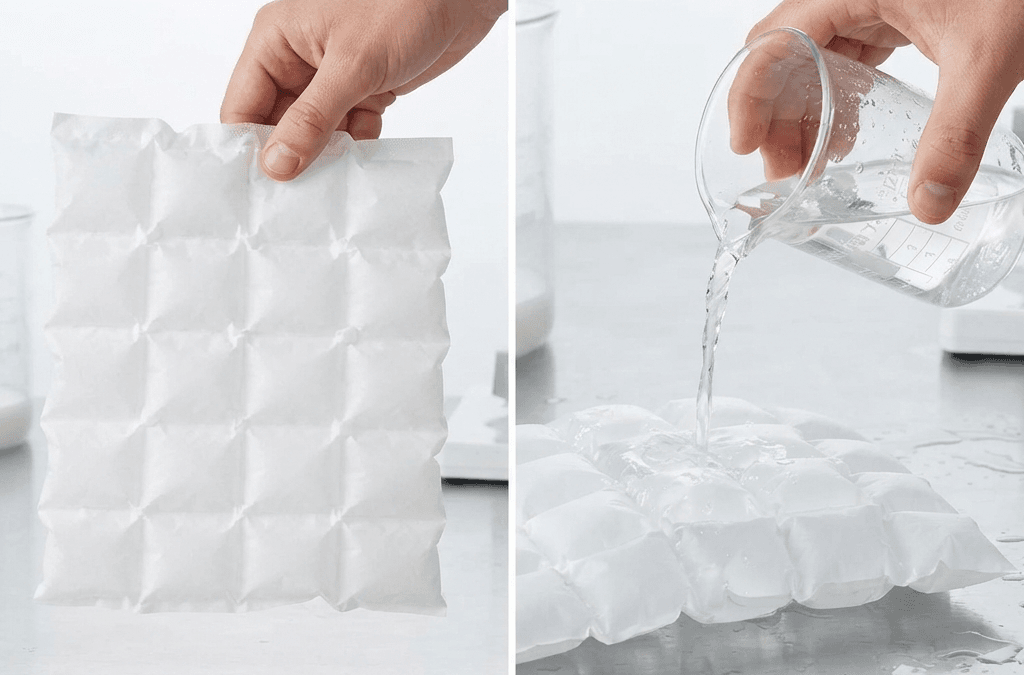
Advanced gel ice packs are refillable, phase-change cooling packs that hold a shipment inside its required temperature range for 24 to 72 hours without the meltwater, freezer burn, or handling restrictions of wet ice and dry ice. For most 2–8°C and frozen shipments, they are the simplest way to keep pharmaceuticals, food, lab samples, and cosmetics in spec from the packing bench to the customer’s door.
This guide explains how advanced gel ice packs work, how they compare with dry ice and wet ice, how many packs a shipment actually needs, and how to pack a cooler so the temperature curve stays flat. If you are still mapping out your wider cold chain, start with why temperature-controlled shipping is essential for modern supply chains.
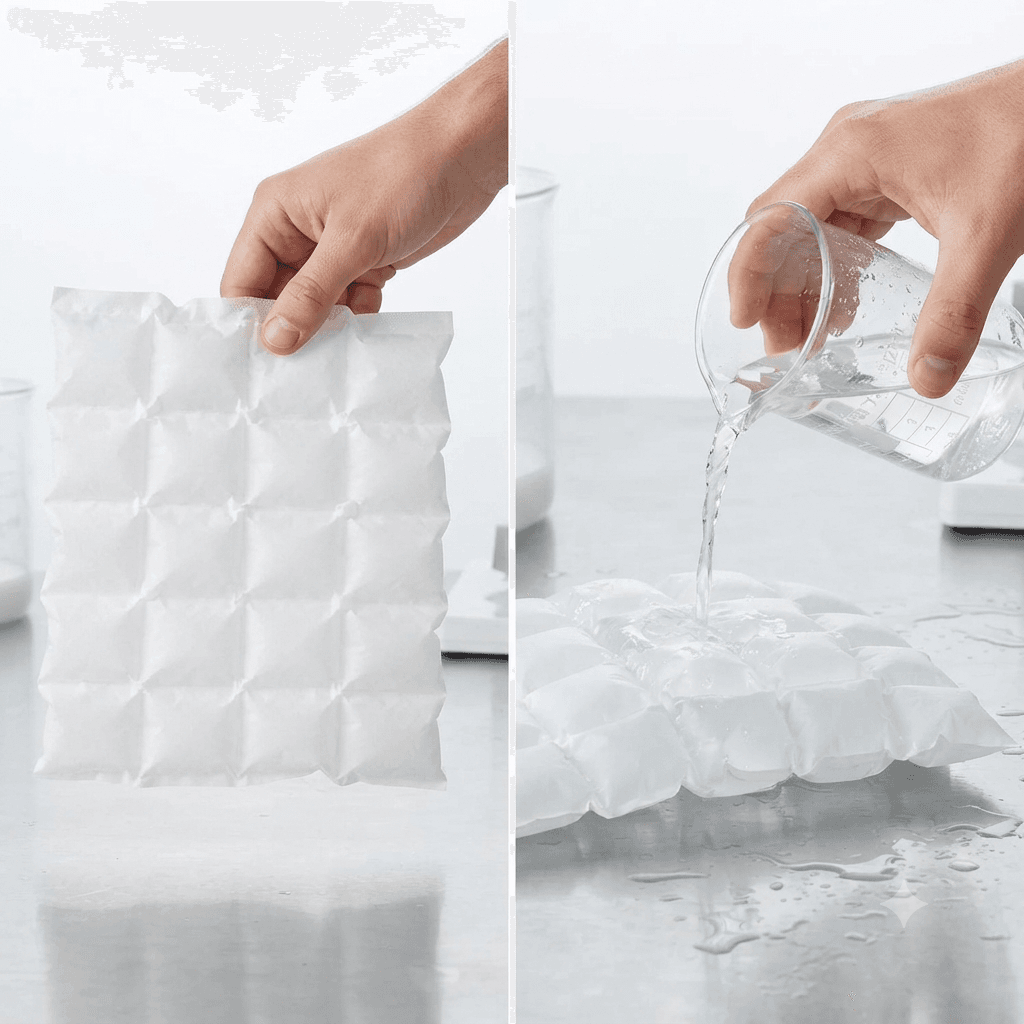
What Are Advanced Gel Ice Packs?
An advanced gel ice pack is a sealed pouch filled with a water-based polymer gel, usually a food-grade cellulose or sodium polyacrylate blend. When frozen, the gel changes phase slowly and releases cold energy at a steady rate instead of dumping it all at once. That phase-change behaviour is what separates a gel pack from a bag of ice.
Three properties matter in shipping:
- Higher latent heat than plain water ice — more cooling energy stored per gram, so the payload stays cold longer.
- No free liquid — if the outer film is punctured, the gel stays put. Cartons, labels, and paperwork stay dry.
- Tunable freeze point — formulations are available at 0°C, -3°C, -12°C, and -21°C, so you can match the pack to the product instead of over-chilling it.
How Advanced Gel Ice Packs Improve Temperature-Controlled Shipping
1. They hold a flatter temperature curve
Wet ice cools aggressively at first and then fails quickly once it melts. A gel pack releases energy across its whole phase change, so the data logger shows a gentle slope rather than a cliff. That flat curve is what keeps a 2–8°C product from drifting out of range on day two of transit.
2. They prevent moisture damage and contamination
Melted ice soaks cartons, lifts labels, smears barcodes, and creates a contamination risk in food and clinical shipments. Gel packs release nothing. Scanners read the first time, and the box arrives presentable instead of soggy.
3. They ship without hazardous-goods paperwork
Dry ice is classified as a dangerous good (UN1845) and brings labelling, venting, air-waybill declarations, and per-package weight limits with it. Non-toxic gel packs carry none of that. For teams shipping daily, removing that paperwork step is often the biggest operational win.
4. They cut cost per shipment through reuse
A quality gel pack survives hundreds of freeze-thaw cycles. Closed-loop operations that get packs back from clinics, depots, or subscription customers see the cost per shipment drop sharply after the first few rotations. Our breakdown of reusable gel ice packs for commercial applications covers the reuse maths in detail.
5. They fit the box instead of fighting it
Flexible packs drape around vials, pouches, and odd-shaped products, and rigid slab packs line cooler walls cleanly. Better fit means fewer air gaps, fewer voids to fill, and often a smaller carton, which lowers dimensional-weight freight charges.
6. They make shipments predictable and auditable
Because gel packs behave consistently, a packout that has been validated once can be repeated with confidence. That repeatability is what auditors, quality teams, and regulated customers actually ask for.
Gel Ice Packs vs. Dry Ice vs. Wet Ice
| Factor | Advanced gel ice packs | Dry ice | Wet ice |
|---|---|---|---|
| Typical range held | -21°C to 8°C | Below -70°C | 0°C to 5°C |
| Usable duration | 24–72 hours | 12–48 hours (sublimates) | 6–24 hours |
| Meltwater | None | None | Heavy |
| Hazmat handling | Not required | Required (UN1845) | Not required |
| Reusable | Yes, hundreds of cycles | No | No |
| Best for | Chilled and frozen goods, 2–8°C pharma, food, samples | Ultra-cold biologics, frozen bulk | Local, same-day deliveries |
The short version: use dry ice when the product genuinely needs ultra-cold, and advanced gel ice packs for everything else. Most commercial cold chains fall into the second group. If you are weighing options across a product line, see our guide to choosing the right cooling solution for your business.
How Many Gel Packs Does a Shipment Need?
Pack quantity depends on transit time, ambient temperature, and the insulation of the shipper. These figures are a practical starting point for a validated test, not a substitute for one.
| Transit time | Cooler size | Starting point (moderate ambient) |
|---|---|---|
| Up to 24 hours | 6–12 litres | 2–3 packs, 500 g each |
| 24–48 hours | 12–20 litres | 4–6 packs, 500–750 g each |
| 48–72 hours | 20–40 litres | 6–10 packs, 750 g–1 kg each |
| Summer or desert routes | Any | Add 30–50% more coolant and upgrade insulation |
Always confirm the packout with a data logger on a real lane before rolling it out. Testing protocols from ISTA give a recognised framework for that validation.
How to Pack a Temperature-Controlled Shipment
- Pre-condition everything. Freeze packs solid for at least 24 hours and pre-chill the product and the shipper. Warm packaging eats coolant capacity.
- Line the walls. Place packs against the inside faces of the insulated shipper so cold surrounds the payload rather than sitting under it.
- Add a barrier layer. Use bubble wrap or a corrugated divider between packs and product so nothing freezes by direct contact. This matters most for 2–8°C vaccines and biologics.
- Fill the voids. Air is the enemy. Fill empty space with insulation or filler so warm air cannot circulate inside the box.
- Add the logger. Place a temperature logger next to the product, not next to a gel pack, so the reading reflects what the product experienced.
- Seal and label clearly. Mark the carton as temperature-sensitive and include handling instructions for the receiver.
Industries That Depend on Gel Ice Packs
- Pharmaceutical and biotech — vaccines, insulin, and biologics that must stay within 2–8°C, in line with CDC vaccine storage and handling guidance.
- Clinical and diagnostic labs — blood, tissue, and specimen transport between collection sites and testing facilities.
- Food and meal-kit delivery — seafood, meat, dairy, and prepared meals shipped direct to consumers.
- Healthcare logistics — hospital and clinic resupply, covered further in how cooling products improve efficiency in healthcare logistics.
- Cosmetics and personal care — heat-sensitive serums, probiotics, and active formulations.
Common Mistakes to Avoid
- Using partially frozen packs because the freezer was not given enough time.
- Matching pack weight to product weight instead of to transit hours and ambient heat.
- Placing gel packs only on top or only on the bottom of the payload.
- Reusing a shipper whose insulation has been crushed or soaked.
- Skipping data loggers, which leaves you with no evidence when a customer disputes a shipment.
Frequently Asked Questions
How long do advanced gel ice packs stay cold?
A properly pre-frozen gel pack in an insulated shipper holds temperature for roughly 24 to 72 hours. Duration depends on pack weight, insulation quality, ambient temperature, and how many times the box is opened.
Are gel ice packs better than dry ice?
They are better for chilled and standard frozen shipments because they are reusable, non-hazardous, and need no special documentation. Dry ice remains the right choice only when the product must stay below -70°C.
Can gel ice packs be shipped by air?
Yes. Non-toxic gel packs are not classified as dangerous goods, so they travel by air without hazmat declarations. Always confirm the specific carrier’s packaging rules before booking.
How many times can a gel ice pack be reused?
A commercial-grade pack handles hundreds of freeze-thaw cycles. Retire any pack with a punctured film, a leaking seam, or gel that no longer freezes uniformly.
Do gel ice packs freeze the product they protect?
They can if a sub-zero pack touches the product directly. Use a 0°C or -3°C formulation for 2–8°C goods and always place a barrier layer between the pack and the payload.
What temperature should gel packs be frozen at?
Freeze at -18°C or colder for a minimum of 24 hours, and longer for packs of 1 kg and above. Lay them flat with space between packs so air can circulate.
The Bottom Line
Advanced gel ice packs give temperature-controlled shipping three things that are hard to get any other way: a predictable cooling curve, a dry and presentable package on arrival, and a coolant you can reuse instead of rebuy. Match the freeze point to the product, size the packout to the lane rather than the parcel, validate it with a logger, and the same configuration will hold up shipment after shipment.