
Temperature-sensitive shipments leave very little room for error. A vaccine that sits at 12°C for a few hours, a box of seafood that warms past 40°F, or a lab sample that thaws on a loading dock can all become worthless before they reach the customer. The cooling products inside the box are what stand between a successful delivery and a costly loss.
In this guide, we explain what makes a shipment temperature-sensitive, what goes wrong when cooling fails, and how to choose gel ice packs and insulated packaging that hold the right temperature from dispatch to delivery.
Quick answer: Quality cooling products matter for temperature-sensitive shipments because they keep goods inside a safe temperature range for the full transit time. Well-made gel ice packs stay cold longer than ice, don’t leak meltwater, aren’t regulated as hazardous materials like dry ice, and help businesses prevent spoilage, follow FDA and CDC guidance, and keep customers coming back.
What Are Temperature-Sensitive Shipments?
Temperature-sensitive shipments are goods that lose safety, quality or value when they move outside a set temperature range during transport. The right range depends on the product. Some items must stay frozen, many need refrigeration, and others only need protection from heat.
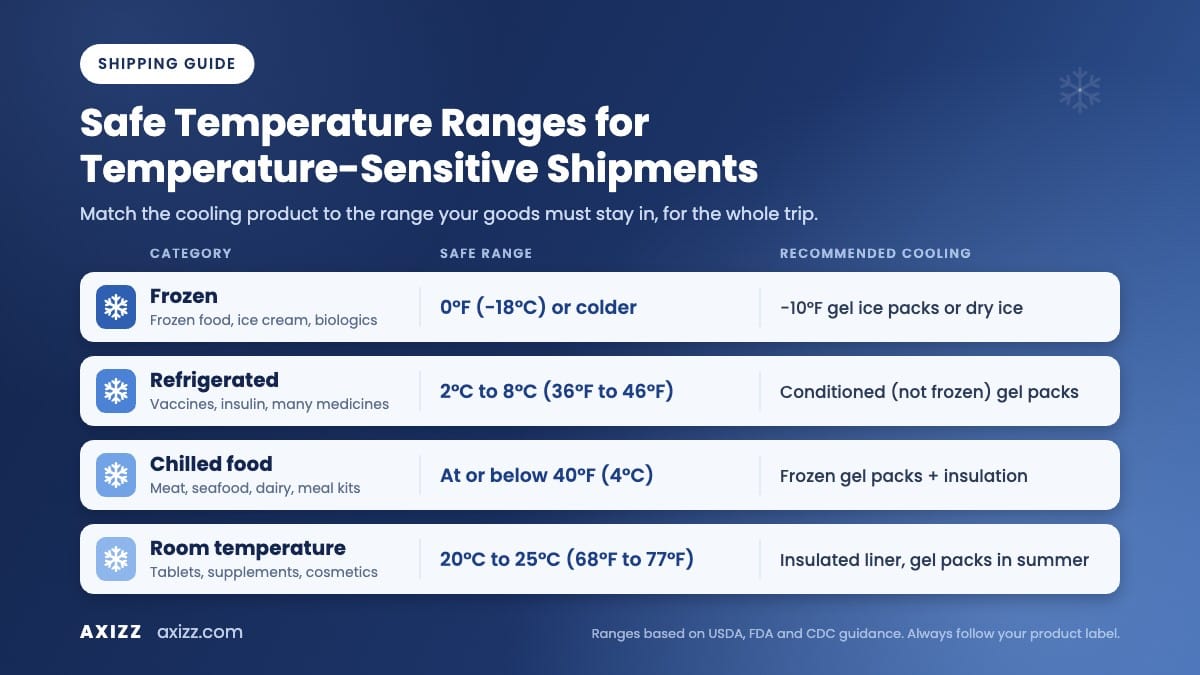
| Category | Typical safe range | Common examples |
|---|---|---|
| Frozen | 0°F (-18°C) or colder | Frozen food, ice cream, some biologics and lab samples |
| Refrigerated | 2°C to 8°C (36°F to 46°F) | Vaccines, insulin, many prescription drugs |
| Chilled food | At or below 40°F (4°C) | Meat, seafood, dairy, meal kits |
| Controlled room temperature | 20°C to 25°C (68°F to 77°F) | Many tablets, supplements and cosmetics |
| Cool, never frozen | Above freezing, varies by item | Cut flowers, live plants, chocolate |
If your product fits any row in this table, the packaging has to be planned around its exact range, not around a guess.
What Happens When Temperature-Sensitive Shipments Get Too Warm or Too Cold?
Temperature failures are expensive, and they often stay hidden until someone opens the box. According to the IQVIA Institute, the biopharma industry loses about $35 billion a year because of failures in temperature-controlled logistics. The World Health Organization has also estimated that up to half of vaccines can be wasted globally, with temperature control and logistics among the main causes.
For food, the biggest risk is safety. The USDA warns that bacteria grow fastest between 40°F and 140°F, a range it calls the Danger Zone. A chilled order that drifts into that zone can look perfectly fine and still make someone sick.
The usual results of a cooling failure include:
- Spoiled or unsafe products that have to be thrown away
- Medicines and vaccines that lose potency with no visible change
- Refunds, reshipping costs and chargebacks
- Failed audits and compliance problems
- Bad reviews and lost repeat customers
7 Benefits of Quality Cooling Products for Temperature-Sensitive Shipments
Not every cooling product performs the same. A cheap pack that leaks or thaws in six hours can cost far more than it saves. Here is what quality cooling products bring to temperature-sensitive shipments.
1. Longer and More Predictable Hold Time
Quality gel ice packs release cold slowly and evenly, so a pack-out tested for 48 hours keeps working for 48 hours. Our THERMAPACK™ (-10°F/-23°C) gel ice packs are formulated to give about 15% longer protection than standard gel ice packs. That extra margin helps when a carrier runs late or a delivery gets missed.
2. Stable Temperatures Without Meltwater
Regular ice turns into water that soaks labels, weakens cardboard and can ruin packaged food. Gel packs return to a gel when they thaw, so the product stays dry. We compare the two in detail in why gel ice packs are better than traditional ice.
3. Easier Compliance
US food shippers fall under the FDA’s Sanitary Transportation of Human and Animal Food rule, which requires temperature control for foods that need it for safety. Clinics and pharmacies follow the CDC’s vaccine storage and handling guidance. Reliable coolants make it much easier to hold the required range and show that you did.
4. Lower Shipping Costs and No Hazmat Paperwork
Dry ice is regulated as a hazardous material in air transport, with marking and quantity rules explained in the FAA’s dry ice fact sheet. Non-toxic gel packs avoid that extra handling for refrigerated and chilled goods. Lightweight options like the CRYOPAK® Flexible Ice Blanket also help keep package weight and freight costs down.
5. Leak and Puncture Resistance
Cheap packs split when a sharp corner or a heavy stack presses on them. Laminated bags and a structured gel formula, both used in our THERMAPACK™ line, reduce punctures and leaks that could damage the very goods you are trying to protect.
6. Reusability and Less Waste
Reusable gel ice packs can be refrozen and used again, which cuts replacement costs for businesses with return loops, like meal kit brands, labs and clinics. Fewer single-use coolants also means less waste. Learn more about how reusable gel ice packs support sustainable business practices.
7. Customer Trust and Repeat Orders
A customer who opens a box and finds cold, dry, undamaged products is far more likely to order again. The cooling inside the box is part of the product experience, even if the customer never thinks about it.
Gel Ice Packs vs. Regular Ice vs. Dry Ice: Which Is Best for Shipping?
| Feature | Gel ice packs | Regular ice | Dry ice |
|---|---|---|---|
| Best for | Refrigerated and chilled goods | Short local trips | Deep-frozen goods and samples |
| Temperature | Around 32°F (0°C), down to -10°F (-23°C) with low-temperature formulas | 32°F (0°C) | -109.3°F (-78.5°C) |
| Meltwater | None | Yes | None (turns into gas) |
| Hazmat rules for air shipping | No | No | Yes (Class 9, UN1845) |
| Reusable | Yes | No | No |
| Risk of freezing chilled items | Low when conditioned | Low | High on direct contact |
For most refrigerated and chilled temperature-sensitive shipments, gel ice packs give the best mix of cost, safety and ease of use. Dry ice makes sense only when goods must stay deeply frozen for the whole trip.
How to Pack Temperature-Sensitive Shipments Step by Step
A good pack-out follows the same basic steps every time:
- Confirm the product’s safe temperature range and the longest realistic transit time, weekends included.
- Pick an insulated container, such as an EPS foam cooler, or a THERMAPACK™ thermal shipping envelope for lighter loads.
- Condition your gel packs. Freeze them fully for frozen or chilled goods, or refrigerate them for 2°C to 8°C products so they don’t freeze the contents.
- Pre-cool both the product and the shipping box.
- Place coolants on the bottom, sides and top, with a buffer layer between the packs and anything that must not freeze.
- Fill empty space to limit air movement, then seal the box.
- Add a temperature indicator or data logger for high-value or regulated goods.
- Ship early in the week so packages don’t sit in a warehouse over the weekend.
Test the pack-out before you scale it. Send a sample box through the conditions it will actually face, summer heat included, and adjust the number of packs until it holds the range for the full journey. Our guide on how temperature-controlled packaging protects sensitive products covers insulation choices in more depth.
How to Choose Cooling Products for Your Temperature-Sensitive Shipments
- Match the coolant to the range. Standard gel packs suit chilled goods, -10°F formulas suit colder holds, and dry ice is best kept for deep-frozen items.
- Size packs to the box. Flexible packs and ice blankets wrap around odd shapes, while rigid packs fit standard coolers.
- Check build quality. Look for thick or laminated film, strong sealed seams and a non-toxic gel.
- Plan for volume. High-volume shippers can make their own packs with the TEMTRO™ Gel Pack Production System.
- Test before you buy in bulk. Run sample shipments with your real products and routes.
You can compare sizes and formulas in our gel ice packs collection, or see how pharmaceutical distributors and modern supply chains put them to work.
Frequently Asked Questions
What is a temperature-sensitive shipment?
A temperature-sensitive shipment is any package of goods that can spoil, lose potency or become unsafe if it is exposed to temperatures outside a specific range during transit. Common examples include vaccines, insulin, fresh and frozen food, lab samples, flowers and some cosmetics.
How long do gel ice packs keep a shipment cold?
It depends on the pack size, the insulation and the outside temperature. A well-insulated box with enough quality gel packs commonly holds refrigerated temperatures for 24 to 48 hours, and some pack-outs last up to 72 hours. Always test your own pack-out on a real route to confirm.
Are gel ice packs better than dry ice for shipping?
For refrigerated and chilled goods, yes. Gel packs are reusable, non-toxic and are not regulated as hazardous materials. Dry ice is the better choice for goods that must stay deeply frozen, but it needs hazmat marking for air shipments and can freeze products that should only be chilled.
Can frozen gel packs damage refrigerated medicine?
Yes. Fully frozen packs can push products that must stay between 2°C and 8°C below freezing. Use conditioned (refrigerated, not frozen) packs or add a buffer layer such as cardboard or bubble wrap, and always follow the product’s storage instructions.
What is the best way to ship temperature-sensitive products?
Use an insulated container, the right number of quality gel packs for the full transit time, filler to remove empty space, and a temperature indicator for high-value goods. Ship early in the week with a service fast enough to arrive before the coolant runs out.
Final Thoughts
Temperature-sensitive shipments are only as safe as the cooling products inside them. Reliable gel ice packs and good insulation cost very little compared with one spoiled order, a failed audit or a lost customer.
Axizz supplies gel ice packs, ice blankets, thermal shipping covers and gel pack production equipment for businesses of every size. Browse our cooling products or contact our team for help choosing the right pack-out for your shipments.