
Warehouses and distribution centers move temperature-sensitive goods every day, and a few degrees of drift can turn a full pallet into a write-off. Cooling products for warehouse and distribution center operations exist to close that gap. They hold product temperature through staging, dock transfer and loading, and they keep the people doing the work safe when the building heats up in summer.
This guide explains what these products are, where they fit into daily facility operations, how to choose the right type, and the practices that keep a cold chain defensible during an audit.
Key Takeaways
- Cooling products for warehouse and distribution centers protect inventory in the gaps fixed refrigeration does not cover: staging areas, dock transfers and outbound loading.
- Gel ice packs, phase change panels, dry ice and insulated liners each hold a different temperature range, so the product has to match the payload.
- Cooling vests, neck wraps and cold packs reduce heat stress risk for staff working in non-climate-controlled zones.
- Reusable cooling products lower cost per shipment and cut packaging waste compared with single-use alternatives.
- Documenting pack conditioning and pack-out is what turns a cold chain from a habit into an auditable process.
7 Benefits of Cooling Products for Warehouse and Distribution Centers
Before the detail, here is the short version of what cooling products for warehouse and distribution center operations actually deliver.
- Fewer temperature excursions. Coolant covers the staging and loading gaps where fixed refrigeration stops.
- Lower product loss. Less spoiled, rejected or written-off stock leaving the building.
- Documented compliance. A defined pack-out gives auditors the evidence they ask for.
- Safer staff. Personal cooling products for warehouse teams reduce heat stress in trailers and hot pick zones.
- Steadier throughput. Comfortable pickers keep pace and make fewer errors during peak.
- Lower cost per shipment. Reusable packs replace a recurring consumable line.
- Less packaging waste. Reusable and right-sized formats support sustainability targets.
What Are Cooling Products for Warehouse and Distribution Centers?
Cooling products for warehouse and distribution centers are reusable or single-use items that absorb and hold thermal energy to keep goods, packaging or people inside a target temperature range. In a facility setting they fall into three groups: product-protection items, worker-cooling items, and monitoring accessories that prove the temperature held.
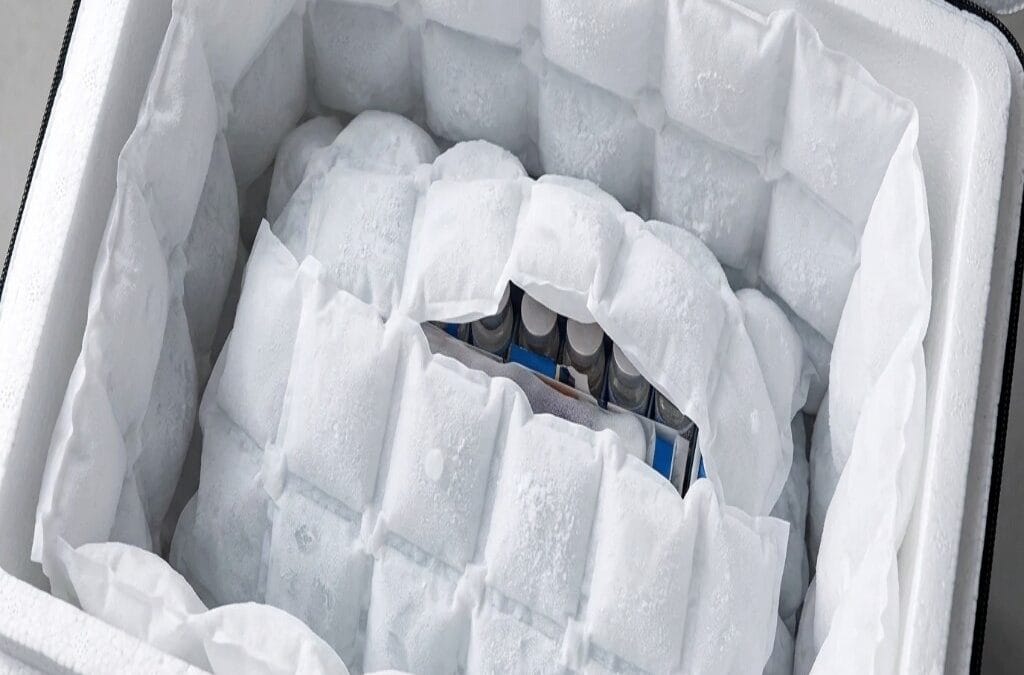
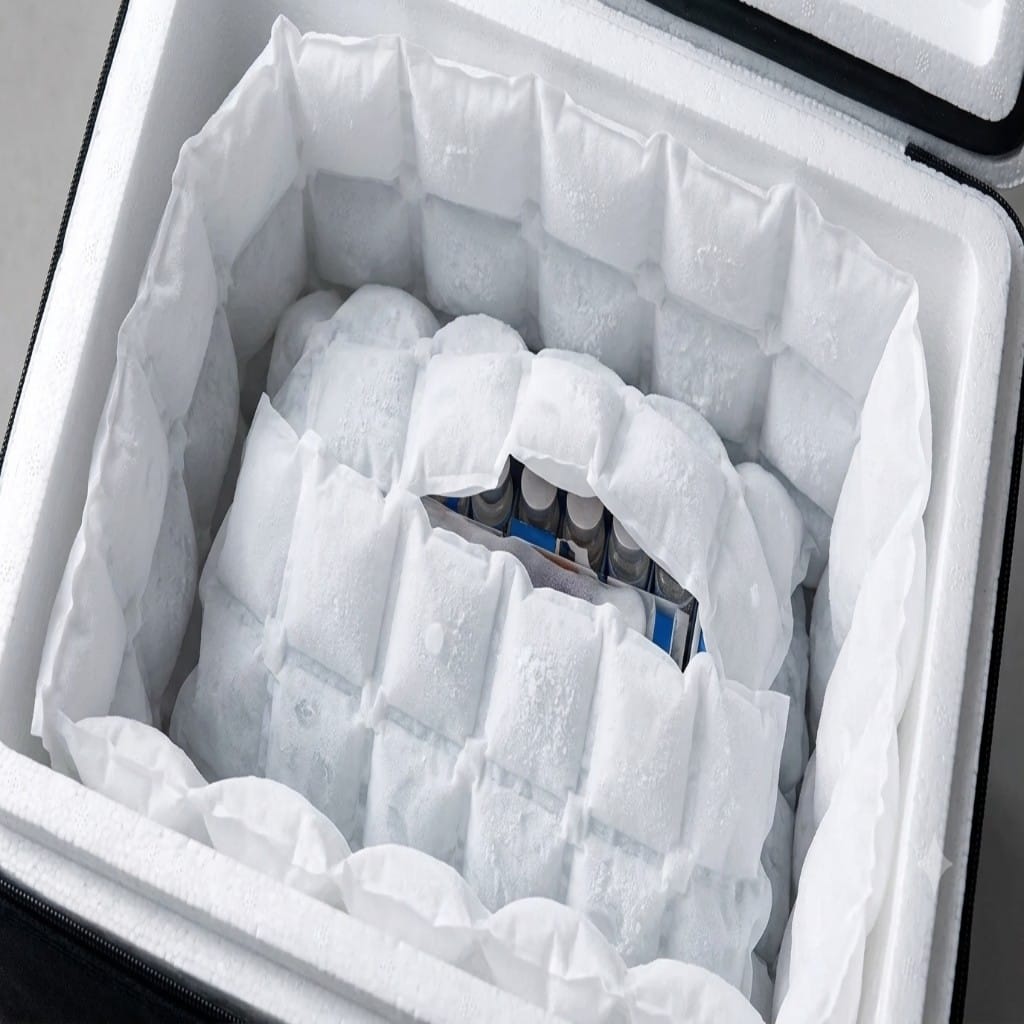
- Gel ice packs. Flexible refrigerant packs that hold a chilled range around the freezing point of water. The workhorse of chilled food and most 2-8°C shipments.
- Phase change material (PCM) panels. Engineered to melt and freeze at a specific set point, such as 5°C or 22°C, which keeps a payload inside a narrow band instead of simply making it cold.
- Dry ice. Solid carbon dioxide at roughly -78°C, used for frozen goods and biologic material. Requires ventilation and handling controls.
- Insulated liners, pouches and shippers. Passive barriers that slow heat transfer and multiply the working life of whatever coolant sits inside them.
- Cooling vests, neck wraps and cold towels. Personal cooling for staff in pick zones, loading docks and other areas outside the conditioned envelope.
- Temperature indicators and data loggers. Single-use strips or electronic loggers that record whether the shipment stayed in range.
Why Temperature Control Matters in Warehouse Operations
Cooling products for warehouse operations earn their place in two ways: they protect what you store and ship, and they protect the people handling it. Both carry a direct cost when they fail.
Protecting temperature-sensitive inventory
Pharmaceuticals, vaccines, fresh and frozen food, diagnostic samples, cosmetics, adhesives and lithium batteries all have a defined storage window. Common ranges include 2-8°C for refrigerated medicines, 15-25°C for controlled room temperature stock, and -20°C or colder for frozen goods. A product that leaves its window may still look fine, which is exactly the problem: the loss is invisible until a customer complaint or a failed inspection surfaces it.
Most excursions do not happen inside the cold room. They happen in the minutes between the cold room and the trailer. Passive reusable gel ice packs and insulated liners cover that handoff without adding mechanical equipment to the floor.
Meeting cold chain and compliance requirements
Food distributors in the United States operate under the FDA rule on sanitary transportation of human and animal food, which requires temperature controls to be specified, used and recorded. Pharmaceutical distributors work to good distribution practice expectations on top of that. In both cases an auditor is looking for evidence, not intention, so the coolant type, the conditioning time and the pack-out method all need to be written down. Our guide to temperature-controlled shipping covers the transit side of the same chain.
Reducing shrink and rework
Cooling products for warehouse operations are usually judged on unit price, which misses the point. Every temperature failure carries a second cost after the product itself: the replacement shipment, the expedited freight, the credit memo and the customer conversation. Passive cooling is cheap next to any of those. For high-value or regulated stock, the packs and liners on a single pallet usually cost a fraction of one rejected delivery.
How Cooling Products Protect Warehouse Workers
Not every use of cooling products for warehouse sites is about the product. Picking, palletizing and trailer loading are physical jobs, and trailers parked in the sun get far hotter than the building around them. Heat stress reduces accuracy, slows pick rates and raises injury risk well before anyone reaches a medical emergency. OSHA heat guidance centers on water, rest and shade, and personal cooling gear supports all three by extending how long a worker stays comfortable between breaks.
- Cooling vests with removable packs for staff in trailers and non-conditioned zones
- Neck wraps and cooling towels for shorter, high-exertion tasks
- Reusable cold packs at break stations for rapid cool-down
- Cold packs in first aid kits for strains, sprains and impact injuries
Teams that already stock coolant for product usually find that worker cooling adds little to the program. The same freezer space and the same rotation habits cover both. See how cooling vests improve workplace safety for the detail on fit and wear time.
How to Choose Cooling Products for Your Facility
Selecting cooling products for warehouse and distribution center use comes down to three numbers. Start with the payload temperature, then the longest realistic time out of refrigeration, then the ambient conditions on the worst day of the year. Those three numbers decide the coolant type and quantity more than any other factor.
| Cooling product | Typical range | Best suited to | Reusable |
|---|---|---|---|
| Gel ice packs | Around 0°C | Chilled food, general 2-8°C with a buffer layer | Yes |
| PCM panels | Tuned set point (e.g. 5°C, 22°C) | Strict 2-8°C and controlled room temperature | Yes |
| Dry ice | About -78°C | Frozen goods, biologics, long transit | No |
| Insulated liners and shippers | Passive barrier | Any parcel or pallet needing extended hold time | Varies |
| Cooling vests and wraps | Body cooling | Staff in hot pick zones and trailers | Yes |
Beyond the range, check freezer capacity for conditioning packs overnight, the durability of the outer film against pallet handling, and whether the format fits your existing cartons. If sustainability targets are part of the decision, reusable formats and right-sized packaging usually move the number further than any single material swap. Our overview on choosing the right cooling solution walks through the same trade-offs by business type.
Best Practices for Using Cooling Products in Distribution Centers
Buying the right coolant is half the job. These habits are what make cooling products for warehouse operations perform the way the spec sheet says they will.
- Condition packs fully. A partially frozen gel pack performs nothing like a fully conditioned one. Set a minimum freezer time and hold to it.
- Qualify your pack-out. Test the configuration against your worst-case route and ambient temperature, then lock it as a standard.
- Keep coolant off direct product contact where freezing damage is a risk, using a buffer layer or corrugated divider.
- Stage cold work last. Pull temperature-sensitive orders at the end of the pick sequence so they spend the least time out of the cold room.
- Rotate and inspect reusables. Pull packs with seam damage or leaks; label batches so the oldest go out first.
- Log the shipment. Indicators or loggers on high-value loads give you evidence and a feedback loop on pack-out performance.
- Train seasonal staff. Peak season hires handle the same cold freight, and most excursions trace back to a missed step rather than a failed product.
Where Cooling Products Fit by Industry
The mix of cooling products for warehouse and distribution centers shifts by sector. Grocery and meal-kit distributors lean on gel packs and insulated liners for last-mile parcels. Pharmaceutical and clinical operations lean on PCM panels and validated shippers because the tolerance is tighter. Healthcare logistics teams often run both, plus dry ice for specimens. If your operation sits in that space, see how cooling products improve efficiency in healthcare logistics.
Frequently Asked Questions
What cooling products do warehouses use most?
Reusable gel ice packs and insulated liners are the most common cooling products for warehouse and distribution center use, because they cover the widest range of chilled shipments at the lowest cost per use. PCM panels come next for tightly regulated loads, and cooling vests are standard where staff work outside the conditioned area.
Where do cooling products for warehouse operations fit in the cold chain?
They cover the passive links: staging before dispatch, dock transfer, outbound loading and last-mile delivery. Mechanical refrigeration handles fixed storage, while cooling products for warehouse teams handle everything in motion between those points.
How long do gel ice packs stay cold in a warehouse shipment?
It depends on pack size, how many packs are used, the insulation around them and the ambient temperature. A fully conditioned pack inside a quality insulated shipper commonly holds a chilled range for 24 to 48 hours, while the same pack in a bare carton may last only a few hours. Always qualify the configuration you actually ship.
Are reusable cooling products worth it for distribution centers?
For any facility shipping cold freight regularly, yes. Reusable cooling products for warehouse use pay back quickly. Reusable packs are recharged in existing freezer space, they remove a recurring consumable line, and they cut packaging waste. Single-use coolant still makes sense for one-way shipments where nothing comes back.
What temperature should a distribution center hold for pharmaceuticals?
Refrigerated medicines typically require 2-8°C, controlled room temperature stock 15-25°C, and frozen products -20°C or below. Always follow the manufacturer label and your own quality agreement, since specific products carry their own limits.
Do cooling vests actually help warehouse workers?
They help by extending the time a worker can stay comfortable between rest breaks, which supports the water, rest and shade approach regulators expect. They are a supplement to hydration and scheduled breaks, not a replacement for them.
Getting Started
Cooling products for warehouse and distribution centers are not a large investment, but they sit on a lot of value. Map the points where your product leaves controlled temperature, measure how long each gap really lasts, and match a cooling product to the longest one. Add worker cooling for the zones your HVAC does not reach. Done well, the whole program costs less than a single rejected pallet and removes a recurring source of claims.
Axizz supplies cooling products for warehouse and distribution operations, including gel ice packs, insulated packaging and cooling accessories. Contact our team to talk through the right configuration for your facility.