
Gel ice packs have quietly replaced traditional ice in most professional cooling setups, and the reason is simple: ice melts, gel packs do not. Loose ice was the default for decades because it was cheap and everywhere. But the moment you need cooling that is predictable, clean, and repeatable, a bag of ice starts costing far more than it saves.
This guide compares gel packs and traditional ice on the things that actually matter to a business: how long they hold temperature, what they do to your packaging, what they cost over a year, and how safe they are around food and skin.

What Are Gel Ice Packs?
A gel ice pack is a sealed pouch filled with a water-based gel, thickened with a food-safe polymer or cellulose. Freeze it and the gel stores cold energy the same way ice does. The difference is what happens next. As it warms, the gel softens instead of turning into a puddle at the bottom of your box.
The formula can also be tuned. Manufacturers adjust the gel so it holds a specific temperature band, which is why you will see packs rated for frozen shipping, for 2 to 8 degree Celsius pharmaceutical transport, and for general refrigerated goods. Ice only knows one temperature, and it does not stay there for long.
Gel Ice Packs vs Traditional Ice at a Glance
| Factor | Gel Packs | Traditional Ice |
|---|---|---|
| Cooling duration | 8 to 48 hours by size and pack count | 4 to 8 hours in most shippers |
| Meltwater | None, the gel stays sealed | Heavy, soaks cartons and labels |
| Reusable | Yes, hundreds of freeze cycles | No, single use every time |
| Temperature control | Formulated to hold a target range | Fixed at 0 degrees, then climbs fast |
| Shipping weight | Lower for the same cooling power | Higher, and it does not shrink |
| Food and skin contact | Sealed barrier, no direct contact | Direct contact and runoff risk |
| Cost per use | Falls with every reuse | Full price on every shipment |
| Storage | Stacks flat in a freezer | Needs an ice machine or bulk buys |
7 Reasons Gel Ice Packs Beat Traditional Ice
1. No meltwater, no ruined packaging
This is the one that costs businesses the most money. A few pounds of ice turns into a few pounds of water inside a sealed box. That water softens corrugate, lifts labels, stains paperwork, and can push a shipment into a damage claim. Gel packs keep the water inside the pouch where it belongs.
2. They stay cold longer
Gel has a higher viscosity and a slower phase change than plain water, so it releases cold energy more gradually. In practice that means a properly sized gel pack holds a shipment in range for a full day or more, while the same volume of ice is often finished before the truck reaches its second stop.
3. Reusable, so the cost per use keeps falling
Ice is a repeat purchase. A gel pack is an asset. Refreeze it and the second use costs you nothing but freezer time. For closed-loop operations such as catering, meal kits, clinical routes, and equipment rental, packs come back and go straight into the freezer for the next run.
4. They hold a target temperature, not just “cold”
Colder is not always better. Vaccines, biologics, fresh produce, and many prepared foods are damaged by freezing just as much as by heat. Gel formulations can be set to plateau in a chilled band instead of dropping product below freezing, which is something a bag of ice cannot do.
5. They fit the product instead of fighting it
Most gel packs stay pliable after freezing, so they wrap around bottles, trays, vials, and awkward shapes. That contact matters. Even coverage means fewer warm pockets and a more consistent temperature reading when the box is opened at the other end.
6. Cleaner and safer around food and skin
Melting ice pools at the bottom of a cooler and moves between products, which is a cross-contamination problem in any food operation. A sealed pack has no runoff and wipes down between uses. For cold therapy, the soft outer film also spreads the cold across the skin instead of concentrating it in one freezing spot.
7. Lighter shipments and less waste
Because gel packs hold temperature longer, you need less coolant mass for the same transit time. Lower weight means lower freight cost on every parcel, and reusing packs instead of dumping ice water keeps single-use volume out of the waste stream.
Where Gel Ice Packs Are Used
Cold chain shipping and logistics
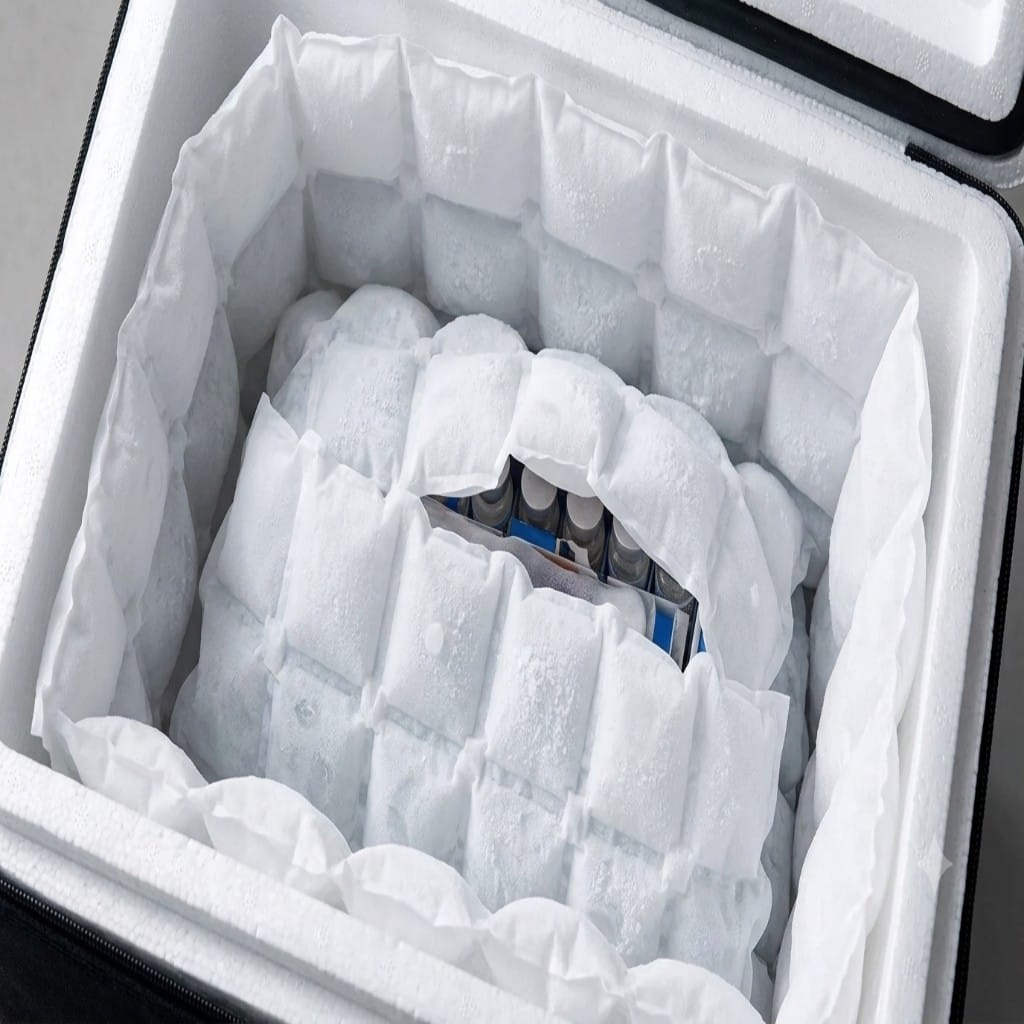
Parcel carriers do not care about your product, only your box. Gel packs paired with insulated liners give a shipment a predictable temperature curve you can validate and repeat, which is what auditors and customers ask for. This is covered in more depth in our guide to temperature-controlled shipping for modern supply chains.
Healthcare and pharmaceuticals
Specimens, vaccines, insulin, and lab reagents move under strict temperature rules with real consequences for a breach. Formulated gel packs hold the required band without freezing the payload, and they can be conditioned before packout so the pack starts the trip at the right temperature.
Food and grocery delivery
Meal kits, seafood, dairy, and prepared meals all have to arrive below 40 degrees Fahrenheit to stay out of the temperature danger zone described by the FDA food safety guidance. Gel packs get them there dry, which matters when the box sits on a doorstep for an hour.
Cold therapy and recovery
Clinics, physiotherapists, and athletes use flexible cold compresses because they mould to a knee, shoulder, or back and stay usable straight out of the freezer. If that is your use case, see how cold therapy products support everyday wellness.
The Real Cost Comparison
Ice looks cheaper on the invoice and it usually is, once. Run the numbers across a year and the picture flips, because ice bills you again on every single shipment while a gel pack bills you once.
- Purchase cost: ice wins per unit, gel wins per use after the first few cycles.
- Freight: gel packs carry more cooling per pound, so parcels weigh less.
- Damage claims: no meltwater means fewer soaked cartons and fewer credits issued.
- Labour: no ice machine to maintain, no scooping, no draining coolers.
- Product loss: a tighter temperature band means fewer spoiled or frozen goods.
For operations shipping at volume, producing packs in house changes the maths again. A gel pack production system lets you fill your own packs on site at a fraction of the delivered cost of pre-made ones.
How to Get the Most Out of Your Gel Packs
- Freeze them fully. Most packs need 24 hours at minus 18 degrees Celsius. A half-frozen pack fails halfway through the trip.
- Lay them flat. Freezing packs flat keeps them stackable and easy to place around product.
- Surround, do not stack on top. Cold falls, so packs on top and along the sides beat packs at the bottom.
- Use insulation. A gel pack in a bare cardboard box is wasted. Pair it with an insulated liner or cooler.
- Test your packout. Run a data logger through your worst-case route once, then standardise the pack count from the result.
- Inspect before reuse. Retire any pack with a split seam, a pinhole, or a hard crease.
Frequently Asked Questions About Gel Ice Packs
Are gel ice packs colder than ice?
Not necessarily colder at the start, but they stay cold longer. Ice sits at 0 degrees Celsius and then warms quickly once it has melted. Gel releases its stored cold more slowly, so the average temperature over a full transit is lower and steadier.
How long do gel ice packs stay frozen?
It depends on pack size, how many you use, and the insulation around them. A small pack in a lunch bag runs 6 to 8 hours. Larger packs inside an insulated shipper commonly hold 24 to 48 hours.
Are gel ice packs safe around food?
Packs made with food-grade gel and food-contact film are safe to place directly against sealed food. The gel itself is not meant to be eaten, so any pack with a damaged seal should be thrown out rather than used.
How many times can a gel pack be reused?
A good quality pack handles hundreds of freeze and thaw cycles. The film usually fails before the gel does, so handling and storage decide the real lifespan more than the number of cycles.
Can gel packs be used for hot therapy too?
Some can. Dual-purpose gel compresses are made to be microwaved or warmed in hot water as well as frozen. Check the product label first, because packs built only for freezing can rupture when heated.
The Bottom Line
Traditional ice still has a place when you need cheap cooling for a few hours and mess is not a problem. For everything else, gel packs win on duration, cleanliness, temperature control, and cost across a year of shipments.
If you are choosing coolant for a commercial operation, start with the transit time and the temperature band you have to hold, then size the pack count around it. Browse our range of gel packs and cooling products or read more on reusable gel ice packs for commercial applications.